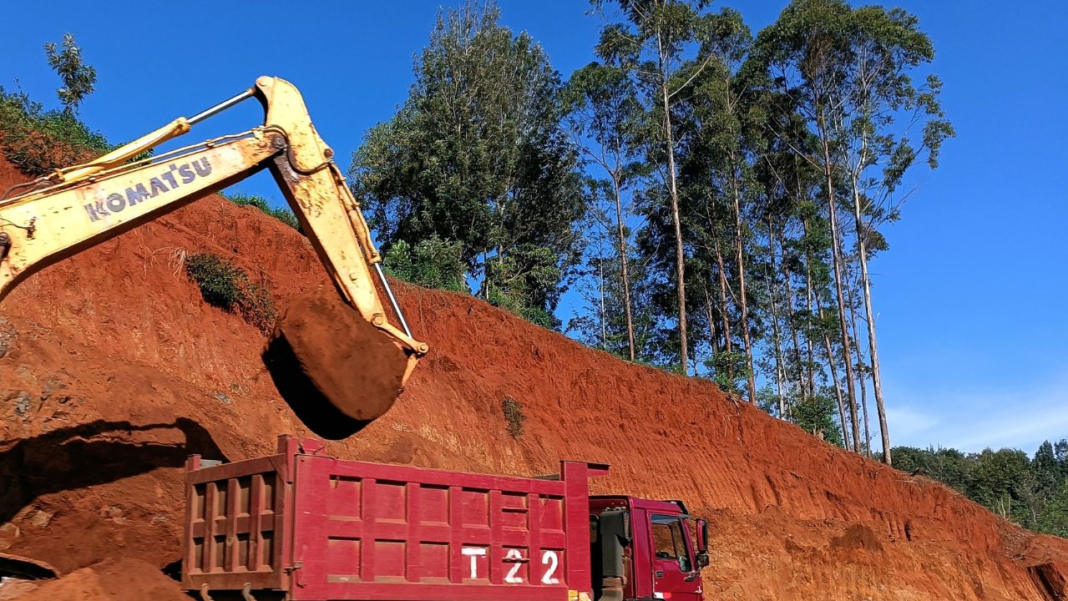
Before steel crossed Kimuka, morning arrived on bare soles pressing into the earth, you could hear the footsteps before you saw the people. The striking red volcanic soil, rich in iron oxides, would easily stick and cake sandals when wet. The visible stains on livestock, rusty-red taint would easily contrast with the green and dry-yellow grass of Kajiado plains. By evening it had climbed into socks, fingernails, cooking pots and mattresses.
Women woke first. Muthoni was up by the time roosters crowed. The cold had unsettled sleep, her mother was crouched beside the hearth, blowing gently into last night’s charcoal until the first orange glow returned. Smoke thickened beneath the low roof, stinging Muthoni’s eyes. Then the shifting would begin from the bomas, hooves scrapping, goats jostling inside a thorned fence. Across the ridge another woman was sweeping her compound with a twig broom. Her body was already answering an inherited clock that did not care for alarms.
She tied her leso, its fabric softened by years of washing, and stepped outside. The air smelled of smoke from last night’s fires, of damp grass, of goats shifting in their sleep. Somewhere, a rooster misjudged the hour. She balanced the yellow jerrycan on her hip and began the walk toward the borehole, joining other women. They greeted each other softly, voices low, conserving breath for the climb back.
“How is your mother?”
“Still coughing.”
“And the calves?”
“Two survived.”
These talks were an inventory of the bodies, of loss, of endurance.
The land around Kimuka was neither spectacular nor gentle, it was useful. It fed goats and cattle, held maize when the rains were kind, punished when they were not. Nobody remembered making these paths. They wandered between grazing fields and boreholes, around anthills and stubborn acacia. Children widened them on their way to school, chasing one another across the plains with duty shoes and tucked uniforms. By the time bicycles found them, they already knew their destinations.
Muthoni could tell of an afternoon storm before the first cloud gathered. She watched the termites instead, two or three days before heavy rains, the anthills opened new breathing holes and winged termites gathered just beneath the crust, waiting. Earth always inhaled before it drank. If the swallows flew low enough to skim the grass and the weaver birds abandoned the acacias for thicker thorn trees, she knew to bring in the washing before noon. Clouds have their language too, the harmless ones drifted high, white and lazy above the Ngong Hills. The dangerous ones arrived with the wind from Ndeiya in uneven layers, their bellies dark as wet cowhide, carrying the smell of rain before they carried the rain itself. Her mother had taught her that land listened.
“When you speak badly of it,” her mother used to say, “it will refuse you.”
So Muthoni spoke kindly, even when the soil cracked beneath her feet during dry seasons, even when crops failed, and hunger thinned the air inside the house. She thanked the ground before planting. She whispered apologies when she spilled hot water into the dirt.
Kimuka was not untouched by the world beyond it. Kameme FM, Radio Jambo and Classic FM carried voices from Nairobi, from further still, and entertainment with an array of music variety. The big Kenya Bus services never came this far, they stopped at Ngong where the tarmac ended. Kimuka belonged to battered Peugeot station wagons, feet and bicycles. Young men left and returned wearing different accents, different trousers. But change came slowly, like erosion noticeable only when you pause long enough to compare before and after.
Until the men in yellow helmets arrived.
They came first as rumours.
“They say a big road is coming.”
“Not a road.”
“A train.”
“How can a train come here?”
Then as paper, maps unrolled on makeshift tables under trees. Lines drawn with a confidence that did not ask permission. The first time Muthoni saw them, she was returning from the market, a sack of maize flour balanced on her back. A cloud of dust rose ahead of her, thick and unfamiliar. She slowed, her heart lifting into her throat, not fear exactly, but alertness.
The men moved differently, their steps were decisive and clipped. They had boots that pressed the soil flat. They wore helmets the colour of ripe mangoes, and vests bright enough to wound the eye. Their voices cut through the air in sharp syllables that rose and fell like a song without a chorus. They did not look lost, that was what unsettled her most. The elders gathered beneath the mugumo tree, where disputes had always been weighed.
Women stood at the edges, children hovering like birds. A government official spoke, his Swahili careful and polished. “Maendeleo” he said, smiling as if at a child. “Maendeleo mambo leo.”
The Chinese men stood behind him, nodding politely. They bowed slightly when introduced, hands at their sides. One of them smiled at Muthoni, not the broad, casual smile of the Kenyan men she knew, but something smaller, contained. She did not smile back.
That night, Kimuka hummed with speculation, fires burned longer, and the stories grew louder.
“They will take our land.”
“They will bring jobs.”
“They will leave when they are done.”
“What about the graves?”
No one had an answer for that. When the earth began to tremble, work began before agreements had finished forming. The machines arrived, huge, growling beasts that bit into the ground with metal teeth. Trees fell in hours that had taken decades to grow. The earth opened, unwillingly, and did not close itself again. Dust rose and stayed suspended, coating tongues, eyelashes, the inside of lungs. It announced itself first through sound. A low vibration, almost imperceptible, crept through the ground. Goats grew restless, while the chickens scattered. Children laughed, then stopped laughing when the laughter echoed strangely against the unfinished concrete. The railway meant wages. Young men lined up early, names written down by officials who mispronounced them and did not apologize. Work was hard, long, and dangerous, but it paid. Women, opportunity arrived sideways, now they did not go fetching firewood in Ngong forest, instead used Jiko to warm their houses and cook.
Kenyans usually imitate sounds not the words themselves. Workers in the construction site would hear “Ni hao.”
Soon, everyone else imitated that without knowing what it means.
“Kuái diăn!” Supervisors would shout it out, and soon even children would hear shouting in the same tonal cadence the Chinese men spoke “Kwadian! Kwadian,”
The Chinese would laugh, when nicknames like Lao were given to them.
Muthoni was approached one afternoon by a local contractor.
“They need someone to cook,” he said. “Someone clean.” She thought of her aging mother, of school fees looming like storms. She agreed. The camp smelled of oil and unfamiliar spices. Rice steamed in large aluminium pots.
The Chinese men ate quickly, efficiently, bowls close to their chests. They spoke among themselves, laughter breaking out in unexpected places. The cook served beef stew; one of the Muthoni now could differentiate them immediately coughed after one spoon, his eyes watery
“Hii pilipili kidogo hivyo, kama ya watoto,” the cook said, trying really hard not to laugh.
“Siwezi, sitaki.” He walked, shaking his head. A puff of smoke followed after him.
Muthoni learned their habits before their words. Who likes sweet tea? Who refused again, politely but firmly. Who lingered near the fire, homesick perhaps, staring into flames that reminded him of something far away. And she would quietly serve him food before chilli was added.
One of them, quieter than the rest, began to help her without asking. He carried water and chopped vegetables with careful precision. When she thanked him, he nodded, as if gratitude embarrassed him. His name was Li Wei. He worked as a surveyor, walking long distances with instruments balanced on his shoulder, eyes always measuring. But in the evenings, he sat near the cooking area, rubbing his hands together to warm them, and listening. He smelled like tobacco and sandalwood aftershave.
Muthoni spoke little to him at first. She had learned caution early; language has a way of forcing intimacy.
“What is this?” he asked one day, pointing to the stew.
“Githeri,” she said.
“Gi…theri,” he repeated, stumbling.
She corrected him, gently.
In return, he taught her how to say his name properly—not the flattened version others used, but the careful rise and fall that gave it meaning.
Sometimes, he asked about the land.
“Before,” he said, gesturing toward the torn earth, “how?”
She struggled to explain. There were no words for before that did not sound like nostalgia or accusation.
“Alive,” she said finally.
He nodded, as if that answered something he had not known how to ask.
The camp brought other changes: small kiosks sprang up, selling tea, cigarettes, phone credits; everyone adapted quickly. Where the railway cut through paths, they found new ones. Still, not all adaptation was voluntary.
The survey peg stood where one of the fathers had been buried thirty-eight years earlier. Nobody had asked permission before hammering into the soil. The old man knelt, everyone thought he was reading the marker, instead he began brushing away the loose earth with both hands. Slowly, as if searching for misplaced. His fingers reached the stone that marked the grave. He laid both palms on it.
“Hapana!” he wailed and screamed, and never had it been heard a man cry. Four young men tried to lift him away, his body fought effortlessly. Later, some villagers came carrying blankets, and inside, folded bone by bone, silence filled the hollowness.
Li Wei watched that day, his face pale. Later, he stood beside Muthoni as she washed dishes.
“In my village,” he said slowly, choosing his words like stones to step on across water, “we also lost land.”
She looked at him then, truly looked. He was younger than she had thought. There was dust in the creases of his hands.
“And did you get it back?” she asked.
He shook his head.
She poured him tea, taking the cup from her, he winced after the first sip.
“Too hot,” she asked reaching for a jug to pass him
“No,” he smiled awkwardly, “too sweet.”
She frowns. “In Kenya we drink sweet tea.”
He laughs. “In China… we drink tea.”
In that moment, they both stare and laugh. Something shifted between them then—not romance, not yet—but recognition. The quiet understanding of those whose lives had been rearranged by decisions made elsewhere. Their closeness grew in pauses, in shared silences and in the way he brought her oranges from town without explanation. In the way she saved him the crispiest piece of meat.
And one evening, when the ground shuddered beneath their feet and the night insects fell silent, Muthoni realized with a clarity that frightened her that her body had begun to change. She placed a hand on her stomach, feeling something unfamiliar stir.
Outside, the machines roared on.
Her mother was the first to notice; her stomach was not yet visible, but she refused fermented milk and suddenly hated the smell of roasted corn. The hurried footsteps in the morning to spew what was left in her belly from yesterday’s supper.
After everyone was asleep, she added another piece of firewood.
“Muthoni.”
Silence.
“Damu ya mwisho ya mwezi, uliona lini?” When was your last period?
There was no shouting, no aggression or accusations, just silence.
Muthoni’s tears were building a well; her mum kept looking at the fire, then reached her hand over her, “I carried the shame too.” And in that one statement, Muthoni knew she always had a shoulder to lean on.
Muthoni’s pregnancy was a quiet revolution. The red earth of Kimuka no longer felt like hers alone, each step carried a double weight, the weight of her own blood and the weight of the new life forming inside her. Li Wei remained in the camp for months, his quiet attentions folding around her like the softest cloth. The other women in the cooking circle noticed. Whispers became glances, glances became unspoken questions. But Muthoni had learned that survival often required small rebellions hidden in plain sight. Older women brought her mum castor oil, some warned her of carrying heavy water from the river, another insisted she must keep working. In those disagreements and bickering of women, sharing their pregnancy years, she knew this is home, everyone has advice and nobody agrees. That’s Africa!
Evenings became their time. She would sit on a low stool, peeling sweet potatoes, while he balanced precariously on the edge of the firelight. They shared small victories, a word learned in each other’s tongue, the taste of maize cooked just right, the rhythm of a song neither had sung before. Their laughter carried across the dust, momentarily drowning the machine’s roar, as if the earth itself exhaled relief.
Yet, life was not kind enough to let joy exist without shadow. One morning, Li Wei was gone. The camp had shifted him to another project hundreds of kilometres away. A note folded in Mandarin lay on the table, stiff and impersonal. She could read it, but it felt like a wind that had swept through her bones.
Muthoni held her stomach, whispering life’s first secrets.
“You will know your father,” she said softly, though she did not know if he would ever return.
“You will know both our worlds.”
Her own world had already changed. The railway cut through grazing lands, and elders mourned their fractured histories. Women adapted, selling tea and vegetables by the roadside, learning to balance currency with tradition. Men worked long hours on the tracks, returning with the weight of exhaustion and an unfamiliar pride in wages earned.
Muthoni carried both worlds now, the one of her mother’s, of soil and stories, and the one of concrete, steel, and foreign voices. The day her son was born, Kimuka seemed to hold its breath. The dust hung low, the horizon blurred into red and gold. She named him Njoroge, for the land that had held her and for the life that would navigate both worlds. His skin was neither fully red-earth brown nor pale as the river stones Li Wei sometimes spoke of. He was the colour of sunrise filtered through dust. Muthoni pressed him close, whispering Maa lullabies she had learned from neighbours, Kikuyu prayers her mother had taught, and the strange syllables of Mandarin she remembered from Li Wei’s tongue. She wove a tapestry of sound around him, as if the weight of languages could shield him from the world’s sharp edges.
Time passed, and the railway did not. Machines gave way to tracks; tracks gave way to trains. The red earth shifted beneath the wheels, carrying stories that had no names. Life pressed on, strange and relentless. Njoroge grew under the shadow of the railway.
The village had changed. Streets were wider; kiosks crowded the edges, children chased balls over dust that now carried metal filings, laughing through coughs and smudges. Language became a battleground of belonging. He spoke Swahili with his mother, but his Kikuyu lilt was soft, borrowed. Maa neighbours teased him, calling him mchina, the child of the foreigner. Mandarin was a whisper he heard from letters his father sent only occasionally, carefully typed, filled with instructions, no warmth.
School was a world of observation and imitation. He learned early to bend his voice to fit, to laugh when laughter was expected, to keep his questions small. But even small questions dug tunnels through his chest: Which world am I allowed to inhabit? Which one will ever claim me? As he grew taller, the railway loomed like a spine through his life. He watched trains glide past, each one a moving promise and a warning. Some days he traced the lines with his finger, imagining the places he might visit. Other days, he felt the tracks vibrate beneath his feet and wondered if his heartbeat followed the same rhythm, foreign yet familiar.
By the time he was sixteen, Njoroge had begun to bridge worlds. He became a volunteer at the local care facility, a place for displaced elders and children orphaned by the relentless march of progress. Here, he carried himself carefully between duty and fear, understanding and inadequacy. He spoke to the elderly in the Swahili of patience, the Kikuyu of care, and sometimes, in the hesitant Mandarin taught by his father, trying to weave himself whole in threads that often refused to join.
Mama Saruni, blind and proud, had lost her son to an accident during the railway expansion. She relied on Njoroge for stories, for warmth, for words that could not hurt. The first time he entered her room, she smelled the dust on his sleeves and whispered, “The soil remembers you, child.”
He wanted to answer, but the words tangled. How could he tell her truths that would shatter the fragile balance of hope she carried? The languages he knew all felt inadequate; the silence between them became a third language he had not learned. Njoroge learned that words were sometimes heavier than the earth itself. He learned that caring meant carrying others’ grief in shapes that had no name. That the tracks outside the facility did not just carry trains they carried choices, consequences, futures, and losses.
The boy who had been born to two worlds now walked daily along the thin lines between them, gathering fragments, trying to hold them steady. Yet he did not yet know if any of it would be enough. The care facility smelled of linoleum and dust, of boiled vegetables and soap. Njoroge moved between rooms, his hands steady, his heart unsteady. He had memorized the routines, who needed water first, which bed blankets smelled faintly of lavender, which elders preferred the shade by the window. Yet, every day reminded him of a truth he could not untangle, some duties could not be rehearsed.
Mama Saruni had been waiting for him in the common room. Blind eyes turned to the sound of his footsteps, ears more alive than sight.
“Child,” she said softly, “come sit.”
He obeyed, lowering himself onto the chair beside her. The red earth, he imagined, was always somewhere beneath them, as stubborn as memory. He smelled dust clinging to the soles of his shoes and felt it echo in his chest.
The nurses had already told him the news, her son, her boy who had laughed like sunlight spilling over her roof, had died at the construction site. The words were simple, yet impossible. They were like dry stones lodged in his throat. How could he carry them across the chasm of language and grief without breaking everything?
He began in Swahili.
“Mama… mtoto wako…”
Her hand tightened in his, a soft grip of expectation.
“I…” His voice failed him. Words fractured, hanging in the air like dust motes. She waited, patient. He tried again, this time in English, fumbling for clarity. The words were sharp, foreign. They slipped from his lips too brittle to land. She felt them but did not understand, yet the weight pressed upon her, as heavy as iron. Njoroge closed his eyes and whispered in Mandarin, the tongue he had almost forgotten, the one his father had spoken only in letters and occasional calls. The syllables were uneven, trembling. He tried to wrap the news in gentleness, in honour, in apology.
She did not understand, and yet she began to weep. The room did not fill with sound, it was filled with recognition. Something had arrived through him that was not language, something raw, incomprehensible, yet truthful. The weight of her loss pressed against his own chest. His palms were wet, hers could not see the tears, but felt them. The care facility, normally a place of quiet routines, held the hum of grief between them, palpable, unspoken.
Afterward, Njoroge helped her lie back in bed. Her hands rested on the quilt, on the earth-patterned fabric, and he imagined the red soil of Kimuka beneath her skin. The world outside hummed with the railway’s passage: steel wheels singing through the night, carrying life and death, promises and ruptures, on and on. Njoroge stepped outside. The evening air smelled of dust, diesel, and mangoes from a distant market. He walked past the tracks, watching the sun strike them like molten metal.
Somewhere in the distance, a train approached, its whistle a ghostly echo of the machines that had uprooted his mother’s life, shaped his own, and now carried her child away forever.
He paused on the embankment. The rails stretched toward the horizon, unbroken, relentless. Somewhere, Li Wei’s voice lingered in memory, gentle as a question.
Somewhere, Muthoni’s lullabies—Kikuyu, Maa, and Mandarin—rose in the folds of air, weaving a tapestry of belonging that never quite settled.
The train drew closer, its sound filled his chest. Njoroge felt the tremor of the earth underfoot, the vibration of lives moving forward without waiting for him, without waiting for anyone. He lifted his gaze to the horizon. The red earth, the railway, the village, the ghosts of both parents, all converged in a line that stretched beyond understanding. He did not move closer to the tracks. He did not walk away. He simply stood, listening. The world continued, indifferent and persistent. And for the first time in his life, Njoroge understood something he could not say aloud, some truths had no words, grief had no language. Belonging carries no borders, and perhaps that, too, was enough. The wind shifted, carrying dust across the rails, across his bare arms, across the empty spaces between two worlds. The train passed, its whistle faded, leaving only silence.
*This piece was submitted to the category of fiction in the Second Global China-Africa Writing Competition (2026) held by CASIN (China-Africa Shanghai International Network). The competition is managed by Dr. Flair Donglai Shi (Shanghai Jiao Tong University), under the directorship of Dr. Jodie Yuzhou Sun (Fudan University). The piece was originally written in English. The Elephant has permission from both CASIN and the author to publish it first. For more details about the competition and CASIN, contact us at casinwriting@gmail.com.