Part One: The Arrival
In the year 1926, when the sun still climbed slow and steady over the red roofs of Ibadan, and the roads remained loyal to dust and earth, a man stepped off a creaking lorry with a chest of tea and a drum wrapped in silk. His name was Li Wei. His Mandarin name meant “strength and clarity,” but here in the sweltering market noise of a Yoruba town, names meant less than survival.
He stood still for a while, his pale robe gathering dirt around the hem, as he surveyed the open stalls, the scent of pepper and charcoal in the air, and the voices—singing, haggling, drumming—all clashing like waves. He had learned some English before the voyage but no Yoruba. Still, his father had said, “Listen first, then speak. The soul of trade is not in words but in silence and eyes.”
Li Wei rented a modest wooden stall at the edge of the market, shaded by an iroko tree. He unpacked the chests carefully. Inside were paper-tied bundles of oolong and pu-erh tea, dried hibiscus leaves, and a small red clay kettle. He placed the silk drum, still wrapped, beneath the table, away from sight.
Part Two: The Girl and the Drum
Adunni had always been drawn to rhythm. She did not speak it. She heard it. In the morning when the cock crowed, she listened to the way the sound bounced off the walls. When her mother pounded yam, Adunni matched the beat with her toes. Her father was a master drummer, his fingers like rivers flowing over goatskin, but he said a woman had no place with the talking drum.
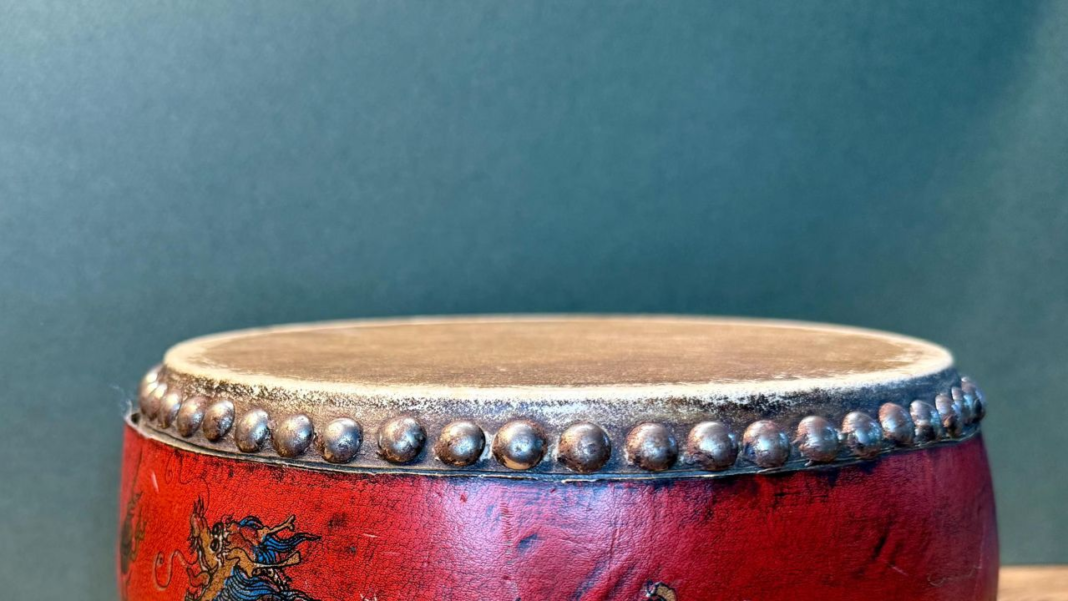
One evening, as the last orange light slipped behind the palm trees, Adunni walked past the market stalls and heard something strange. Not the deep tone of Yoruba drums or the sharp clicks of agogo. This was softer, lighter, like rain on silk. She followed the sound and found the quiet trader sitting cross-legged in his stall, eyes closed, tapping on a round drum with threads along its sides. His fingers moved like breath.
She stayed hidden, watching.
The next evening, she returned. This time, she let a calabash fall so he would notice her. He did. He looked up and smiled, nodding politely. She pointed to the drum. He hesitated, then played a rhythm. She answered by tapping the side of the calabash. He laughed. She laughed.
They did not need words. Rhythm became their tongue.
Part Three: Tea and Talking Drums
Adunni began visiting every evening. Sometimes she brought him fried plantains wrapped in banana leaves. In return, he made tea. The first time she tasted it, she spat it out. It was bitter, earthy, confusing. But he showed her how to brew it properly—three breaths between the pour and the first sip. “Bitterness first,” he said slowly, pointing to his tongue. “Then sweet. Like life.”
She learned his name. He learned hers. She taught him to say “O da bo” when parting. He taught her to say “Zài jiàn.”
By the fourth week, she could mimic the Chinese rhythm he played. He began sketching her symbols—trees, moons, characters that looked like dancing legs. She showed him cowrie shells, songs, proverbs.
They crafted a new rhythm—hers from the village grove, his from distant mountains. They played in secret by the riverside. She closed her eyes and imagined her ancestors nodding in approval. He thought of his grandfather, who once told him, “Play to remember, not to impress.”
But not everyone approved.
Part Four: Drums of Disapproval
Rumours spread quickly in small towns. The elders whispered that Adunni had forgotten her place. Some said she had given her spirit to the foreigner. Her father summoned her.
“Why do you follow this man?”
“Because he listens.”
“A drummer listens to the spirits, not strangers.”
He forbade her from seeing Li Wei.
Meanwhile, a British officer visited Li Wei’s stall. He admired the tea, asked questions about his homeland, then warned him gently. “The Empire has eyes everywhere. Do not involve yourself in village matters. We value peace.”
Days later, Li Wei’s stall was raided by colonial soldiers. His tea was inspected, his papers scrutinised. The silk drum was taken.
Adunni cried when she heard.
That night, she crept into the colonial outpost, barefoot and trembling. Her cousin worked there as a cleaner. He helped her find the drum. She wrapped it in her shawl and ran like wind until she reached Li Wei’s hut.
She placed the drum before him.
He touched it as if touching memory. Then he looked at her and said one word: “Play.”
Part Five: The Farewell Performance
He was leaving. Word came that the British had ordered him to relocate to Lagos or face deportation. He packed slowly. She watched in silence.
“One more rhythm,” she said.
They went to the sacred grove before dawn, when the birds had not yet woken and even spirits were yawning. She brought her calabash. He brought the silk drum.
They sat on opposite stones. At first, they played softly—his tone light like falling leaves, hers deeper, steady. Then they built it, layer upon layer, call and response, east and west, past and future. Her eyes closed, his open. Their rhythms spoke to the earth.
A few villagers gathered, then more. Even her father came. He did not speak.
When the sun rose, the music stopped. Li Wei stood. He bowed to her, to the land, to the people.
He left with nothing but a sack of dried tea.
Part Six: The Silk Within
Years passed. Nigeria changed. Colonisers left. Drums became symbols of resistance, then celebration.
Adunni grew old. Her fingers bent, her hair grey. But every evening, she sat on a mat outside her hut and played her calabash.
Children gathered. She told them the story of a man from a land beyond oceans who spoke through rhythm and tea.
She would unwrap a piece of silk, faded now, and reveal the drum. Its surface worn, its threads loose.
“This,” she would whisper, tapping it gently, “is what happens when two souls listen.”
The drum sang softly, a voice between languages, and the children listened, as if they too could hear the rhythm of an old friendship still echoing across time.
Part Seven: Echoes
One day, a stranger arrived in the town. He wore a plain jacket and a soft grey hat. He spoke slow Yoruba and better English. He said he was Li Wei’s grandson.
Adunni’s granddaughter brought him to the old mat where Adunni sat. She could barely hear, but when she saw the man’s eyes, her hands trembled.
He bowed, just as his grandfather had done.
From a small bag, he brought out a scroll. It was written in Chinese but had a Yoruba translation beneath. It told of a tea merchant who had once traded in Nigeria and whose spirit had never left the land.
He had named his tea company “Adun Wei” — meaning “sweet clarity.”
Adunni laughed so hard she cried. She handed the silk drum to him. “Take it,” she said. “It belongs to both of us.”
He tapped it once. It sounded exactly like it had decades ago — like silk meeting earth, like a river returning home.
And for the first time in years, Adunni closed her eyes, smiled, and let the rhythm carry her away.
–
*This piece was submitted to the category of fiction in the Second Global China-Africa Writing Competition (2026) held by CASIN (China-Africa Shanghai International Network). The competition is managed by Dr. Flair Donglai Shi (Shanghai Jiao Tong University), under the directorship of Dr. Jodie Yuzhou Sun (Fudan University). The piece was originally written in English. The Elephant has permission from both CASIN and the author to publish it first. For more details about the competition and CASIN, contact us at casinwriting@gmail.com.