
From the rhythms of Maasai traditional music to the international climate stage, Leshao Sopia Leshao is using his art to tell a story that goes beyond entertainment.
The Maasai musician, popularly known as Leshao Leshao, is turning Maa music into a platform for conversations on climate change, Indigenous rights and the challenges confronting pastoralist communities.

Raised around the Maasai Mara, Leshao grew up observing the close relationship between communities, livestock, wildlife and the environment.
Traditional songs and oral storytelling were part of his upbringing, a cultural system through which generations have preserved history, knowledge and identity.
Today, he is using that same tradition to speak about a changing environment.
Leshao says the effects of climate change are increasingly visible in pastoralist communities, where prolonged droughts, changing rainfall patterns and floods can disrupt access to water and pasture and threaten livestock-dependent livelihoods.
For him, climate change is therefore not an abstract issue discussed only at international conferences.
It is something communities experience in their daily lives.
“I am not a climate scientist, but I am an artist with a voice and a platform.”

That realisation has shaped his decision to combine music with climate advocacy.
Leshao began his musical journey in 2019 while in high school before taking his craft more seriously in 2022 while at university.
His decision to sing in Maa is deliberate. He believes music can help preserve the language and cultural heritage of the Maasai while showing younger generations that embracing education and modern opportunities does not require them to abandon their identity.
His songs explore a range of subjects, including Indigenous culture, love, education, gender equality, justice and climate change.
His work has since attracted attention beyond his community.
Leshao was named Rift Valley Male Artist of the Year and has featured on platforms including Global Citizen and Nation Media.
In May 2025, Global Citizen featured him through its Emerging Creatives programme, which highlights artists using their creativity to address social issues.
His climate advocacy has also led to collaboration with Spring of the Arid and Semi-Arid Lands, commonly known as SASAL.
The partnership resulted in climate-focused songs including Esipata Oloing’ange and ESIANA.
Esipata Oloing’ange was featured by Global Citizen and performed in Meguarra village in Narok County, an experience Leshao says was significant because it brought the climate message back to the community that inspired his work.
Rather than relying solely on scientific terminology, he uses lyrics, traditional sounds and lived experiences to make climate issues easier to understand.
His approach has also taken him beyond Kenya.
Leshao has participated in international climate spaces including COP29, SB62, COP30 and SB64, where governments, researchers, civil society organisations and other stakeholders discuss climate action.
For him, these platforms provide an opportunity to bring Indigenous and pastoralist perspectives into conversations that are often dominated by technical and policy language.
He argues that communities affected by climate change should not only be subjects of discussions but should also contribute their knowledge and experiences to the solutions.
His journey is unusual in another respect.
Away from music and advocacy, Leshao is a trained civil engineer. He graduated from Meru University of Science and Technology in October 2024.
He sees no contradiction between engineering and music.
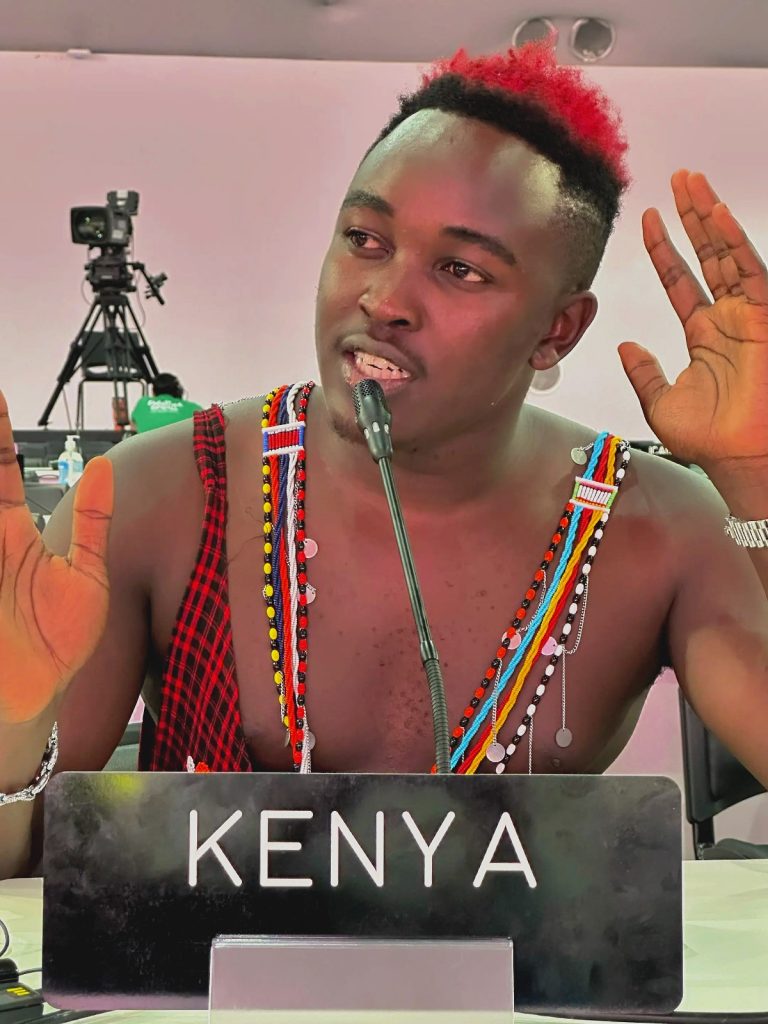
Engineering, he says, has taught him problem-solving and discipline, while music gives him a different way of communicating ideas and connecting with people.
His parents initially wanted him to focus on education and establish a professional career. Their attitude towards his music changed as they witnessed his commitment and understood the purpose behind his work.
Now, Leshao hopes his music can do more than build his career.
He wants it to help preserve Maa language, amplify Indigenous voices and encourage conversations around climate change, education, gender equality and justice.
He acknowledges that music cannot solve the climate crisis on its own.
But he believes artists can help make environmental challenges visible and give communities a platform to tell their own stories.
For Leshao, the future of climate advocacy is therefore not only about policies, scientific data and negotiations