
Kirinyaga Governor Anne Waiguru has committed to rehabilitate roads in the vast Mwea irrigation scheme which have been in deplorable condition for a long time.
Speaking during a meeting with rice farmers and local leaders, Waiguru said though maintenance of the on-farm roads lies with the National Irrigation Authority (NIA) which manages the rice scheme, the delay in rehabilitation was affecting transportation of rice from farms.

The Governor committed to provide machinery and fuel to facilitate murraming of the roads which have been impassable for long, thus affecting cost of production.
She said that with the upgrading, it will now be easy for rice farmers to transport their produce to the market and also reduce the cost of transport.
Waiguru further urged residents of Mwea to safeguard the region’s development gains by sustaining support and constructive engagement with both levels of government.
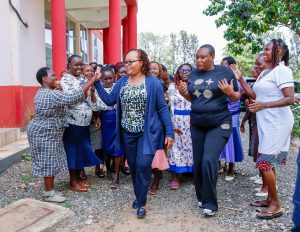
She stressed that the future prosperity of the region depends on protecting investments already made and ensuring that ongoing projects are completed.
Waiguru said the area occupied a strategic place in Kirinyaga County and Kenya’s economy, given its position as the country’s leading rice-producing region and a major contributor to national food security.
“Mwea’s future depends on protecting the gains we have made and advancing its prosperity through forward-looking leadership. We must continue engaging both levels of government, following up on commitments and ensuring that ongoing projects are completed. Our shared priority should be to produce more, reduce the cost of farming, improve farmers’ earnings and create more opportunities for our young people,” she said.
Waiguru cited Mwea’s growing agricultural economy as evidence of the importance of sustained investment and cooperation between the county and national governments. The region currently produces approximately 210,000 metric tonnes of rice annually, valued at about Ksh15 billion.
She noted that behind these figures were thousands of farming households whose incomes depended on reliable irrigation, affordable inputs, access to markets and efficient transport infrastructure. Government interventions, she said, had therefore focused on addressing the practical challenges that constrain production and profitability.
The governor noted that through the county government, rice farmers have received mechanisation support, including harvesters, driers, planters and weeders supplied to farmer groups to reduce labour costs, improve efficiency and minimise post-harvest losses. The county has also invested in agricultural extension services, cooperative development and farmer empowerment programmes to strengthen the entire rice value chain.
At the national level, subsidised fertiliser, seedlings, agricultural programmes and measures to support the market for locally produced rice have provided further assistance to farmers.
The Governor emphasised that such interventions work best when both levels of government continue to collaborate, giving farmers the confidence to invest in their land, expand production and plan for the future.
She also pointed to national government efforts to purchase locally produced rice through the Kenya National Trading Corporation as an important element of market support, noting that dependable markets are essential if farmers are to benefit fully from increased production.
“The government has released Ksh.1 billion co caution rice farmers. This will ensure that before any importation of rice into the country, the government buys rice in Mwea,” she said.
Beyond agriculture, Waiguru outlined a broad development programme aimed at strengthening Mwea’s commercial, social and urban infrastructure. She cited Wang’uru and Makutano markets, the ongoing Sagana Industrial Park, cabro-paved streets in Wang’uru, Kutus and Kagio, and improvements to the road network as investments creating a more supportive environment for business and trade.
She added that the county had invested in healthcare, with Kimbimbi Level Four Hospital nearing completion, alongside the South Ngariama maternity wing, ongoing construction of KEMRI hospital, Mutithi Comprehensive Maternity Block and additional dispensaries intended to bring services closer to residents.
Other investments across the constituency include the ongoing Ksh200 million bulk water project, the construction of ECDE classrooms and the establishment of a seedlings propagation centre in Kangai.
Waiguru noted that cooperation with the national government remained critical to completing major ongoing projects, particularly roads and markets, and sustaining the development momentum across the region.
Her message was reinforced by leaders who credited the progress made to collaboration between the county executive, the County Assembly and the national government.
Speaker Muteti Murimi commended the governor for what he described as equitable development across the county, citing bridges, dams, hospitals and roads among the projects addressing Mwea’s longstanding needs.
“Our Governor has worked hard for the people of Kirinyaga and put the county first. We should not mislead our people. She has fought for development and addressed issues affecting Mwea,” Murimi said.
He also expressed support for Waiguru taking on a greater national leadership role, arguing that women should have a place at the highest levels of national decision-making.
County Assembly Majority Leader Benson Ngahu similarly thanked the Governor for bringing Mwea leaders together and prioritizing farmers’ welfare. He cited Wang’uru Stadium, cabro-paved streets, tarmacked roads, hospitals and markets as examples of the area’s development investments.
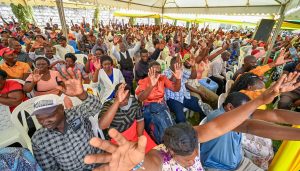
Joseph Ndei, a leader from Tebere Ward, praised Waiguru for her development record and mentorship of emerging leaders. He pointed to her willingness to entrust younger professionals with leadership responsibilities in her Cabinet as evidence of her commitment to nurturing the next generation of leaders.
Women leaders at the meeting also acknowledged the county’s support for community initiatives. Hannah Muthoni thanked Waiguru for providing tents and chairs to community groups, saying the Governor had encouraged more women to participate in leadership and public affairs.
“As Mwea people, we are grateful for your support. You have taught us about leadership and inspired us as women leaders. We are behind you,” she said.
Another resident, Geoffrey Chira, praised the Governor’s direct engagement with residents, noting that she had created opportunities for people to raise concerns and seek solutions to the challenges affecting them. He also lauded the government’s subsidized fertilizer programme, which he noted had made the cost of the vital farm input considerably more affordable.