
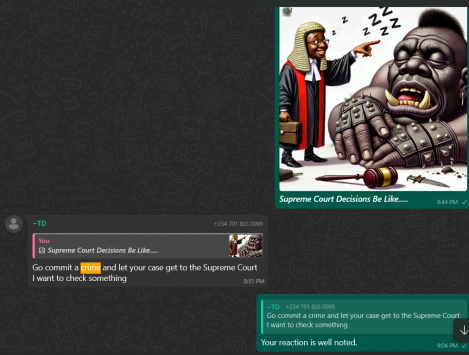
In March 2025, I posted a single-panel cartoon on a civic WhatsApp group that caricatured the Supreme Court: a judge in full wig, a smiling, hulking anarchical figure beside a broken gavel. It was meant as a provocation — a civic jab that asked whether a court’s public trust can survive repeated, controversial decisions. In this case, I was questioning the role Nigeria’s apex court had played in preparing the illegal grounds for the unconstitutional suspension of the elected governor of Rivers State in the oil-rich Niger Delta region which had been the scene of many conflicts around resource control and rival politics. The reaction was immediate. Group messages ranged from sarcasm to outright threats. One respondent typed, “Go commit a crime and let your case get to the Supreme Court — I want to check something.” The joke had not landed as a joke; it was a test.
That exchange is not an isolated outrage; it’s a tiny weather vane. The barrage of abuse, the quick escalation from critique to menace, and the invocation of criminality as a retort reveal how fragile public satire has become.
In Nigeria, mocking power — even in a small civic space — can trigger legal alarms, social shaming, and organized campaigns of trolling that function as a form of extra-judicial censorship. The cartoon and the reaction around it are a microcosm: creative dissent colliding with legal instruments, moral outrage, and digital mobs down the timeline of Nigeria’s nationhood.
Suppression of artistic expression first appeared against Nigerian theatre’s early pillars. Hubert Ogunde, a dramatist who frequently used ethnic Yoruba folklore and oral traditions in his plays to critique colonial rule and later government corruption, was one of the earliest targets of creative suppression His play Yoruba Ronu (Yorubas, Think!), staged in 1964, was such a searing political statement that it was banned in the Western Region of Nigeria in the post-colonial era. The ban was lifted only in 1966 after a change of government. Ogunde’s other works — Strike and Hunger, Otito Koro (Truth is Bitter) — similarly tackled political themes.
Also, when Wole Soyinka – another leading dramatist who was imprisoned for his civic activism to prevent the escalation of the Nigerian Civil War in 1967 – published his experience in a memoir, The Man Died (1972), one of the figures named in the book brought a libel suit against him that was as much about silencing political memory as protecting reputations. Military regimes (which had governed the country for 29 years since its independence in 1960) largely suppressed and constrained artistic expression. One of the earliest and most vivid examples of suppression comes from the case of Fela Anikulapo Kuti, the pioneer of Afrobeat, a musical genre he used for strong social activism and commentary. In 1970, Fela Kuti founded the Kalakuta Republic, declaring it a space independent of Nigeria’s military regime. His music, increasingly political, exposed government brutality, corruption, and hypocrisy. The raid of Kalakuta in 1977 is infamous: approximately 1,000 soldiers stormed his compound, burned down Kalakuta, destroyed his recording studio, beat Fela up, and fatally injured his mother, Funmilayo Ransome-Kuti after throwing her from a second-floor window. Fela’s instruments, master tapes, and the infrastructure of his commune were destroyed. Fela channelled this atrocity into music, penning Coffin for Head of State and Unknown Soldier. His 1977 album Zombie, in particular, used satire and metaphor to indict the military.
Censorship tightened under successive military regimes, targeting platforms that enabled artistic expression. In 1978, a special News Agency of Nigeria was created to vet content to be broadcast on radio and television and, after the 1983 coup, the army itself took charge of monitoring information (Generals don’t read novels”, one writer observed). Set up in 1993, the National Film & Video Censors Board began banning movies deemed indecent or subversive.
Fast-forward to the 2020s and the pattern of suppression of artistic expression in Nigeria continues, albeit with a different dynamic because of the expansion of internet-based technologies and increasing globalization. Moreover, the legal instruments for constraining artistic expression — libel suits, criminal defamation, sharia-based blasphemy charges, broadcasting codes — have continued to raise the cost of creative social commentary and public opinion. Even copyright law has played a role. For example, Nigeria’s new Copyright Act does not fully restore “freedom of panorama”, the principle that allows citizens to photograph, share, or remix images of public artworks and buildings without fear of infringement claims. According to Free Knowledge Africa, this gap means that murals, monuments, or architectural works visible in public can still be restricted from circulation, undermining both digital creativity and civic memory. In effect, even where the streets become galleries of protest, the law lingers in ways that can chill their reproduction or global reach.
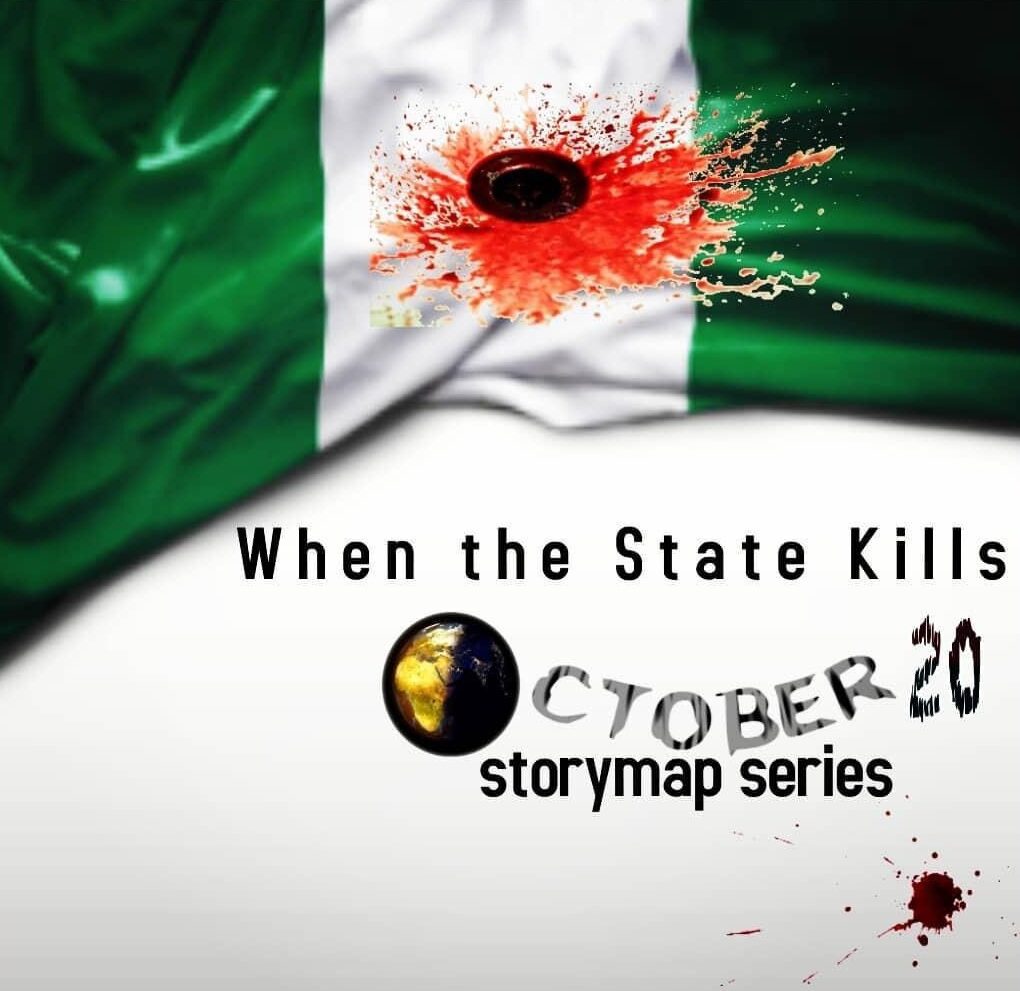
During the #EndSARS protests by Nigerian youths against police brutality (particularly the excesses, extortion and high-handedness of the Special Anti-Robbery Squad [SARS], a notorious unit of the Nigerian Police Force created supposedly to curb violent crimes like armed robbery) in October 2020, art broke out of studios and spilled onto the streets. Protesters used murals, banners, graffiti, and punchy slogans as visual calls to action. Sòrò-Sókè (Yoruba for Speak Up) became not only a rallying cry but also a slogan painted on walls and placards, later adapted to chants, songs, and even digital memes. Murals in Lagos and Abuja depicted clenched fists, bloodied flags, and the faces of victims of police brutality, transforming cityscapes into living canvases of grief and defiance. Protest lyrics too — whether improvised chants or remixed pop songs, including classic tunes from Fela Anikulapo Kuti — blurred the lines between performance and protest, echoing Nigeria’s longer tradition where music and visual art become civic weapons when institutions fail to protect.
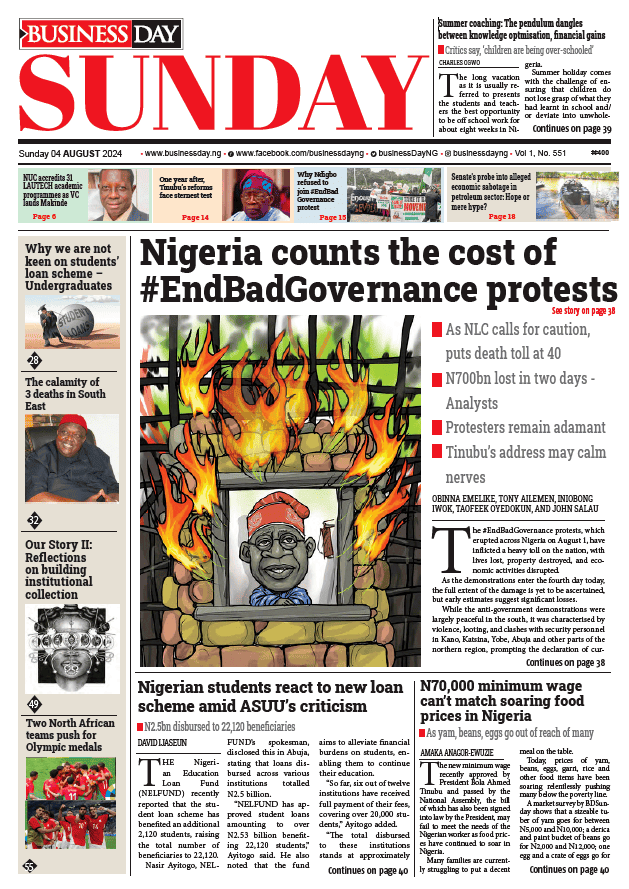
Nationwide protests caused by widespread economic hardship, including the removal of fuel subsidies, staggering inflation, and the rising cost of living broke out in August 2024. Going by the hashtags #EndBadGovernance or #EndBadGovernanceInNigeria, the protests were driven in large part by artistic expressions using a variety of mediums such as music, poetry, and visual art. For example, there was a call for poems by a state chapter of the Association of Nigerian Authors for an anthology capturing “the emotions, experiences and thoughts of Nigerians on #EndBadGovernance”. Street anthems such as Nigeria Jaga Jaga, a reference to a popular protest song by Eedris Abdulkareem critiquing the country’s mismanagement and corruption, appeared again to strengthen the voices of discontent (Tell Your Papa, Eedris Abdulkareem’s sequel release addressing the same issue, was banned by NBC, the broadcasting regulator, in April 2025). The mood of the #EndBadGovernance or #EndBadGovernanceInNigeria was also captured through a mix of visual expressions, from cartoons on the front pages of leading newspapers to street graffiti.
For the average Nigerian, artistic freedom is both celebrated and feared. On the one hand, there is pride in how murals, music, and poetry have amplified protest movements, from Fela’s Afrobeat to Eedris AbdulKareem’s serial protest hits to the chants of Sòrò-Sókè in 2020. Nigerians value art as a mirror of society and as a way of “speaking truth to power” when institutions fall short. But at the same time, many citizens are conscious of the risks that come with bold expression. In northern states, for example, comedians and musicians know that a skit or song judged “blasphemous” can attract heavy penalties — as in the case of Yahaya Sharif-Aminu, who was sentenced to death by a Sharia court in Kano on accusations of sharing an alleged religiously offensive song on a WhatsApp group in 2020, a case that UN experts continue to condemn. Even secular laws like the Cybercrimes Act (amended in 2024) are widely perceived as tools that allow the state to criminalize “offensive” posts, leading ordinary Nigerians to self-censor online. The result is a cautious appreciation of the power of art — citizens often celebrate defiant artists in private, while hesitating to defend them openly for fear of social or legal backlash.
Moral and cultural pressures also shape everyday attitudes towards creative expression. Many Nigerians are protective of art that respects faith and tradition, but conservative clerics or advocacy groups can quickly mobilize against works they deem indecent or offensive. The case of Kano TikTok star Murja Ibrahim Kunya, who was arrested in 2023 after clerics demanded her detention, illustrates how public opinion can be swayed against artists through moral campaigns. Even in the south, cultural groups like the Muslim Rights Concern often threaten lawsuits against musicians or filmmakers whose works “offend religious sensibilities”. For many Nigerians, this creates a climate of double consciousness: they enjoy satire, protest songs, or daring murals when these works affirm frustrations with the government, but they also instinctively police boundaries around religion, sexuality, or community image. This ambivalence means that artistic freedom in Nigeria is not just constrained by law or state power, but also by the unwritten rules of society itself.
To address these systemic attitudes, Unchained Vibes Africa, an art collective, launched the Free the Vibes project in December 2021. Free the Vibes is a monthly series of conversations and performances hosted at Freedom Park in Lagos that puts artistic freedom at the centre of civic debate. It mixes performances — from hip-hop acts to poetry and drumming — with robust conversations about censorship, hate speech laws, and government clampdowns. This initiative is unique in that it isn’t just a showcase of talent; it is designed as a living forum where artists, activists, and audiences connect the dots between creativity and democracy. Its founder, Ayo Ganiu, frames the project as both advocacy and intervention, stepping in when musicians, comedians, or filmmakers are harassed, and using the platform to remind Nigerians that the right to create freely is not a luxury but a constitutional guarantee.
Free the Vibes responds to a culture of repression that artists know all too well: the quick arrests of performers who critique politicians, the silencing of songs branded “defamatory”, and the weight of old military-era trauma that still lingers in Nigeria’s creative industries. Speakers at the opening of Free the Vibes pointed to how artists often self-censor out of fear of fines, bans, or backlash from religious and cultural authorities. Veteran performers like Ade Bantu and Hilda Dokubo used the stage to call on artists to reclaim their voice as educators and agitators, and not just as entertainers. By linking the art of performance with the politics of freedom, Free the Vibes has carved out a space that is both cultural and political, a reminder that creativity in Nigeria is never just about glamour, but about survival and solidarity in the face of censorship.