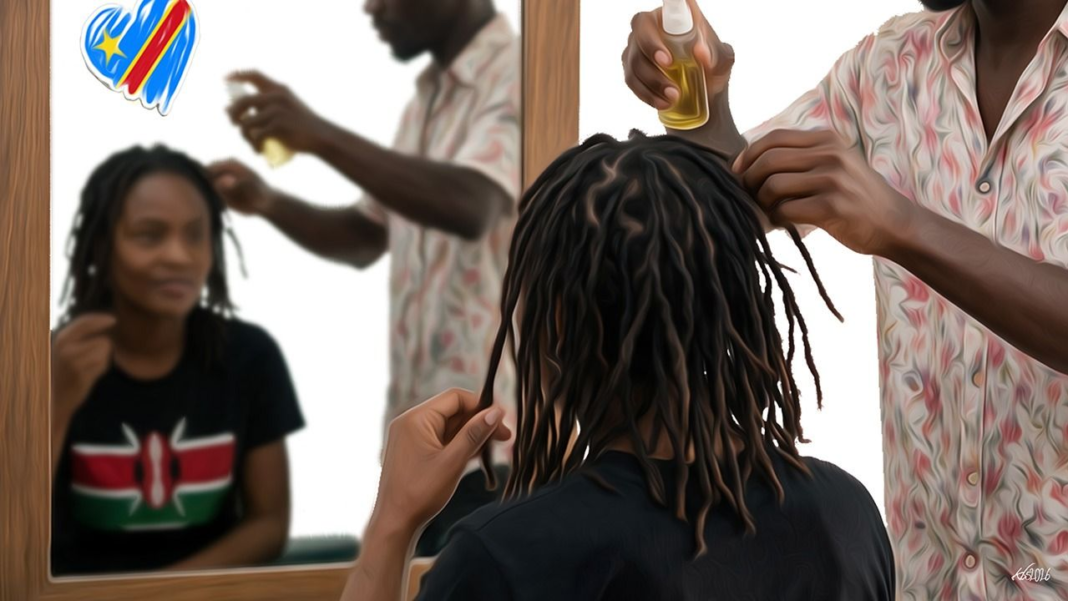
Thirty-three-year-old Emmanuel is a freelance hairdresser in Nairobi. He is a refugee from the Democratic Republic of Congo and has lived in Kenya for six years.
The young man is chic, dressed in designer brands, with a gentle demeanour that reflects his customer-care style in the city’s beauty industry. His calm, collected appearance belies a history of strife, struggle, and an ongoing effort to recover from the decades of armed conflict he witnessed as a child in North Kivu.
‘I will never forget the night when rebels attacked our village in North Kivu. I must have been seven years old at that time. Some people were killed, and there was fire burning everywhere around us.’
Emmanuel narrated his story as he swung around in his styling chair in front of a large mirror that is popularly called a ‘station’ in Nairobi’s hairdressing and beauty salons.
I had visited Emmanuel at the salon where he works. Renting business premises in Nairobi is a significant cost for many young business owners, whether citizen or foreigner. In the beauty industry, most professionals can only afford to rent a mirror and a styling chair as a workstation – hence the name ‘station’.
While occasionally glancing at his WhatsApp notifications for customer bookings, Emmanuel continued to share his story with me.
‘The attack happened many years ago. I still remember how my mother stopped to pack her pot of fish stew and cassava leaves and rice. My father asked her to hurry up, leave the food, and run for safety, but she insisted she would not leave her delicious food. As we all escaped in the dim light of the moon, I recall our neighbours’ comments about my mother’s weird sense of what to salvage. She insisted the food would also save us and she would not leave it behind despite the gunfire. Now I find that funny.’
Emmanuel laughed, trying to find humour in a devastating story.
I knew that talking about traumatic childhood experiences from war would be difficult, so I did not press Emmanuel further about the night armed fighters attacked their village, killing many people and setting houses on fire.
The events Emmanuel witnessed as a child in 2000 were part of the Second Congo War, dubbed Africa’s World War. According to Amnesty International, the DRC’s current conflict has been ongoing since the 1990s, particularly in the eastern part of the country, which borders South Sudan, Uganda, Rwanda, Burundi, and Tanzania.
This armed conflict escalated in August 1998 when President Laurent Kabila fell out with the Ugandan and Rwandan allies who had helped him seize power.
Emmanuel narrated how the fighting between the Lendu-Ngiti and the opposing Hema began as communal land disputes involving farmers and pastoralists. Locals believe politicians and those with mining interests took advantage of these seemingly solvable disputes to fuel the ongoing war. He added that their radio broadcasts often mentioned various fighting groups such as the UPDF (Uganda People’s Defence Forces) and the UPC (United Congolese Patriots).
‘In the news, when we heard that Bosco Ntaganda was in court and wanted to defend himself in Kinyarwanda, we were all shocked, because locally, we knew him as one of us. We never thought he was from Rwanda. He lived here for so long, spoke our language, looked like one of us, and was always involved in Congolese affairs,’ Emmanuel said.
Decades of conflict have been fuelled by ethnic tensions, political rivalries, corruption, and fighting for control of valuable natural resources.
Over time, the war drew in nine African nations, making it one of the largest wars in African history. The 2017 Kivu Security Tracker Report by Jason Stearns and Christoph Vogel listed 132 armed fighter groups operating in North and South Kivu alone.
Today, Emmanuel is one of the over 100 million citizens of the DRC affected by incessant wars. The DRC is the fourth most populous country in Africa and the 14th in the world. Despite decades of war and pandemics such as Ebola, its population has continued to grow steadily.
In 2025, Human Rights Watch reported that the Congolese military and a coalition of armed fighters have continued to attack civilians. The report adds that throughout 2024, the Rwandan army and the M23 armed group indiscriminately shelled displacement camps and other densely populated areas near Goma in eastern Congo.
Emmanuel arrived in Kenya in 2019, just before the COVID-19 pandemic. Earlier, in 2017, reports indicated that more than 4.1 million people had been displaced in the DRC – the highest number since the early years of the conflict in 1993. Today, more civilians have been forced to leave Goma as fighters are accused of blocking humanitarian assistance and committing war crimes.
The UNHCR has been documenting Congolese arrivals in Kenya. Traditionally, Kenya has mainly hosted refugees from the Horn of Africa in refugee camps such as Kakuma and Dadaab in the north of the country at the border with Somalia and Ethiopia.
With the Congolese arrivals, the overwhelming majority of refugees are now urban rather than camp-based. About 60 per cent live in cities like Nairobi, Mombasa, and Nakuru, unlike Somali or South Sudanese refugees who are concentrated in Dadaab and Kakuma. Dadaab still hosts a modest DRC population – 30 per cent of total arrivals.
Mental and social reprieve from the wars
Some neighbourhoods in Nairobi are popular with middle-class refugees and asylum seekers whose families can pay for premium accommodation in the city.
Lavington is a Nairobi upper-middle-class neighbourhood claimed by well-off Kenyans and monied foreigners. It is home to a popular bookstore and library that often hosts author meetups, film screenings, and public talks and lectures.
The bookstore is a venue where Nairobi’s Pan-African spirit comes alive to debate politics, society, and philosophy. Budding writers and thought leaders exercise their intellectual muscle here, among them people who have escaped the wars in Sudan, South Sudan, DRC, and even Somalia.
Here you can bump into DRC citizens – some who recently left Goma because of the war, others who came to study at Kenyan universities in the hope of finding better, safer prospects than at home.
A 2026 UNHCR report shows 7.9 per cent of refugees and asylum seekers in Kenya are DRC nationals. This makes the DRC the third-largest refugee and asylum-seeker population in Kenya, well behind Somalia and South Sudan but ahead of Ethiopia and Burundi.
Like most refugees, Emmanuel may not enjoy the luxuries of Nairobi’s suburbs, but he finds purpose and community at his salon station in the Nairobi Central Business District. His weaving services are much sought after by Kenyan women seeking the latest fashion trends.
Escape from Kilo-Moto, the City of Gold
The last town Emmanuel and his uncles settled in before leaving the DRC was Kilo-Moto, in the far east of the country. They had fled Beni after rebels attacked villages there.
‘Why do you think the rebels were attacking villagers?’ I asked.
‘You see, our villages have large farms. The local farmers grow coffee and cocoa. Many times, the fighters would come when the crops were ready for harvest. They would attack the farmers, even kill them, and take the harvest. In 2014, when we were living in Beni, part of Ituri Province, ADF [Allied Democratic Forces] fighters attacked our village. My brother-in-law, my sister’s husband, was killed. They chopped his head off.’
Emmanuel narrated this horrific incident as if it was something he had already overcome.
‘We had to run and go to Kilo-Moto,’ he added.
‘This region neighbours Uganda. There were mining companies that did not belong to the government of DRC. At least they gave people jobs that paid up to US$300 a month. For many, this was good money, and they built houses, bought nice things in the market, and often came to our salon for hairdressing or haircuts for men. That is where I became a full-time hairdresser. I had dropped out of high school because life was hard in Beni. My parents did not have the means to educate me there, and it was not safe either.’
‘Would you have wished to continue your studies?’ I asked.
‘Yes. While still in Beni, I used to work part-time as a barber with my uncle – that was the money I used to pay my school fees,’ he smiles, adding that he loved studying English, French, and Latin.
‘After that attack in Beni, my uncles and I moved to Kilo-Moto. Here, we thrived because our customers had money from the gold trade. We even rented our own salon, but our success didn’t last, because the fighters attacked the gold mines and we had to run again. I crossed over to Uganda and then into Kenya, where one of my brothers had already fled in 2014,’ Emannuel said while holding a mannequin head displaying a wig.
The gold and ghosts of Kilo-Moto
Agayo Bakonzi has published an overview of Kilo and Moto in the History in Africa journal. The gold mines of Kilo-Moto are located in the extreme northeast of the DRC, near the border with Uganda. The region’s history goes back to the early 1900s, when the Belgian colonial government prospected for gold in the Ituri River.
Mining for gold started in 1905 in Kilo and in 1911 in Moto.
From 1905 to 1919, Kilo-Moto was a colonial state corporation, and gold was mined by the colonial administration. The mines were organized as a special service under the Department of Public Works in the Ministry of the Colonies in Brussels. Africans were recruited from rural areas by the colonial administration to work in the gold mines.
From 1919 to 1926, the gold mines of Kilo-Moto were organized into an autonomous colonial state corporation managed by a board of directors in Brussels. The headquarters of Kilo-Moto mining was then located at 1 Place de Luxembourg, Brussels.
Today, post-conflict Kilo-Moto sits in an eerie peace. Displaced families are still afraid to return. Media reports say local markets and farms remain deserted and plantain, the staple food, is being brought in by trucks from neighbouring Bunia.
From Fally Ipupa to Little Kinshasa: How Congo Lives in Nairobi
Just the other day, while running errands in Nairobi, I saw a massive billboard on Ngong Road advertising Fally Ipupa’s upcoming concert in Nairobi. Fally is one of Kenya’s most loved contemporary Congolese singers.
Locals often identify Kenyan-Congolese people by their French-Lingala accents, which many Nairobi women find very romantic in the men.
Lingala melodies flowing out of shops and homes and wedding guests in Congolese kitenge attire have long been part of local culture in Kenya. Now, a new addition is the aroma and taste of Congolese cuisine in restaurants in Nairobi. The Congolese community in Kenya is growing due to the escalating conflict in Goma and its impact can be seen on the streets as small Congolese-run businesses sprout, including a shopping centre dubbed Little Kinshasa in the east of Nairobi.
In September 2026, Kenyan president William Ruto made a statement that was widely criticized as stirring anti-refugee and anti-immigrant sentiment. Following demonstrations by a section of Kenyan traders against a proposed increase in customs duties, Ruto cited the influx of small foreign traders as part of the problem stifling Kenyan businesses.
Major civil society actors issued press statements rejecting the argument as an incitement to xenophobia and a violation of the East African regional bloc’s agreement on the free movement of people and goods.
While the influx of refugees may put pressure on social amenities, many Kenyans have demanded that the government put in place humane policies to protect both locals and refugees.
Emmanuel may have found peace in Kenya since he arrived six years ago, but there is no guarantee that this will be his home in the long term. ‘Some of my Congolese friends did not come to work today. They are staying indoors after hearing what the president said in the news,’ he said, showing me his UNHC issued refugee card. Emmanuel believes that being documented puts him on the right side of the law.
The ‘Congo Challenge’
Reading Kwame Nkrumah’s book, The Congo Challenge, I found relevance to what is happening in the DRC today in the voice and thoughts of this African political and philosophical giant.
Writing in freshly postcolonial Africa, Ghana’s first president, an ardent and pioneering Pan-Africanist, foresaw what would become of the DRC if its politics remained blind to the realities of neocolonialism and external interests in DRC’s mineral resources. The DRC is home to great lakes, rivers, forests, and people, but has remained mired in conflict over the management of its resources since the Katanga secession attempt. Hundreds of armed militia groups have since continued to fight over resources, driving millions of Congolese people away from their tropical paradise.
Emmanuel witnessed the Second Congo war as a child. Today he is an adult, a refugee in Kenya with dreams of starting a family and building a home. ‘I have a fiancée back at home in Congo. I once had a Kenyan girlfriend but things did not go well between us,’ he said, smiling.
’’So you find time to travel back home? Is it safe?’ I asked.
‘Yes, things are now getting calmer in Bunia. My uncles and parents are still there, I do visit from time to time. The journey is long, we take a bus from Nairobi to Kampala, to Katsama, and finally to Kasindi. Bunia now has people from Uganda and even Kenya. We are slowly building our house again, starting all over again. ‘He said with a sigh.