Preface
As new strangers walk old streets in the shade of mango and frangipani trees, something subtle stirs. Between chopsticks and chapati, “the Middle Kingdom” folds itself into “the Land of Kilimanjaro” both visibly and invisibly. Each story in this collection is a fragment of an unfolding quiet revolution lived not through the headlines, but through bubbling basins, bazaar booths, bodabodas, and blended babel. Here, at Tanzania’s “House of Peace” globalization settles in slowly through the rituals of eating, bargaining, commuting, and socializing. This is Dar es Salaam as it breathes today: a mosaic of memory, migration, and the delicate, daily negotiations of identity.
1: The Gate at Mayfair Plaza
Lemuani has manned the gate at Mayfair Plaza for almost seven years. Rain or shine, dust storms or downpours, he sits on a stool just inside the security booth, a navy blue uniform neatly pressed, his boots always polished, a thermos of chai keeping him company through the long shifts. The gate is both an entrance and a barrier, a place where class, race, and money collide in quiet, unspoken ways. To most who pass, he’s part of the scenery: a nod of acknowledgment, a raised barrier, a wave of the hand. But from where Lemuani sits, the gate is more than just a checkpoint. It is a stage, and he is both a sentry and silent witness to the daily theater of global exchange.
Each morning, the first cars arrive with diplomatic plates or tinted windows, the engines humming with entitlement. Chinese managers in dress shirts, some still tucked into jeans, sweep past without breaking stride. Tanzanian consultants in tailored suits pause to shake his hand, their Swahili polished, their English sharper. Lebanese wholesalers, Indian electronics dealers, NGO interns with clipboards and Mandarin teachers on motorbikes—all pass through the gate like actors in an unscripted play. Lemuani watches them all, tracking their movements with a quiet mind. His name means “the one from a big family” in his Maasai mother tongue language—a fitting reflection of his work as the gatekeeper to a space where people from all walks of life come together like kin. He pieces together relationships, tensions, and alliances from brief exchanges, the rustle of receipts, the clack of heels on tile, the faint scent of imported cologne. He knows who tips, who scowls, who greets him with “Shikamoo” and who pretends not to see him.
Mayfair Plaza is a compressed world. Inside its walls are Chinese restaurants with halal signs, forex bureaus flashing green-lit exchange rates, beauty supply stores, showrooms for solar panels, and shops filled with bolts of imported fabric. It’s all there, carefully arranged under one roof, contained behind a single gate. Lemuani sees the plaza for what it really is: a map of Tanzania’s entanglement with the wider world, drawn not in borders, but in body language and bargaining power.
But the gate is not neutral. It separates as much as it welcomes. To cross it is to declare one’s role as supplier or buyer, local or foreign, insider or outcast. Lemuani stands at the threshold, never fully in, never quite out. He sees what others overlook: the hesitation in a young Tanzanian student’s step as she enters for a translation gig, the forced smile of a Chinese assistant trailing behind her boss, the way certain guards nod differently to Chinese men in sandals than to Kenyan women in heels.
When he’s off-duty, Lemuani often thinks about writing a book, though he’s never put pen to paper. “Stories from the Gate,” he calls it in his mind. Not about himself, but about the quiet collisions he sees each day. How this plaza, like the country beyond it, holds together a thousand unspoken negotiations: of culture, of money, of power. And so, this is where the story begins not inside the shops or the offices, but here, at the gate. Where everyone must pause, even briefly, to be seen. Where entry is both physical and symbolic. Where Lemuani, steady and observant, is the repository of the plaza’s collective memory. Standing at the passage to a world layered with tension, curiosity, and the persistent work of forging cross-cultural connections.
2: Tian Tian
Maria, a polyglot, Italian-blooded, American-born university student, returns once again to Tian Tian Restaurant—her quiet refuge in the middle of Dar es Salaam. It’s a rare kind of place, where both she and the Chinese owners and customers are foreigners in a strange land, far from home, and yet feel strangely at ease. Outside these walls, they’re both called mzungu—a label that flattens nuance, that draws stares, curiosity, and suspicion. But inside, the gazes fall away. Tian Tian has become her home away from home, a patchwork of smells, sounds, and small rituals that steady her when the weight of being far from everything familiar begins to topple her over.
The restaurant is run by an omnipresent, no-nonsense Chinese mama, whose hands are rough from years of labor and whose sharp eyes miss nothing—not a misstep in service, not a wobbly table, not the fatigue Maria carries like an invisible bag on her back. Without a word, she places a steaming cup of jasmine tea in front of her, the scent rising like an exhale. The air is heavy with the fragrance of fried garlic, cigarette smoke, and the muted chatter of uncles speaking Hakka and Mandarin between mouthfuls of bitter greens and pickled vegetables.
Tonight, like most nights, the Tanzanian waitstaff move gracefully between tables, greeting guests with warm calls of “karibu, dada!” and “kaka, samahani!”—bridging the two worlds with ease. In the kitchen, the Chinese chefs, rarely seen but always felt, refill steaming bowls of niúròu miàn and má là xiāng guō for hungry clientele without being asked. It’s a quiet generosity—unspoken, efficient, and deeply cultural.
Maria, who grew up navigating the cramped alleys of New York’s Chinatown and slurping noodles before she could tie her shoes, feels something loosen in her chest. She picks up the chopsticks with ease—slender, lacquered wood she handles like muscle memory—and orders without pause: xiǎo lóng bāo, dòu jiāng, and youtiao.
Her order draws glances from nearby tables. She hears whispers in Mandarin, noting her perfect pronunciation, her confident grip of the chopsticks. She smiles without explanation and lifts a dumpling gently to her mouth, blowing on it just once before taking a bite.
On Sunday mornings, as she walks to church in a dress that billows in the coastal breeze, she passes by Tian Tian’s large windows. Inside, the restaurant hums with life—grandparents, toddlers, aunties, and uncles crammed around circular tables, sharing yuánxiāo and hóngshāo ròu while speaking in a cacophony of Chinese dialects. The parking lot overflows with vans, their doors open and sandals strewn across the pavement. She stops and watches, eyes soft, craving not just the food but the warmth of a multigenerational, communal rhythm she’s always hovered near but never belonged to. Peering inside as she passes, she is reminded of her special seat at the window and her understood silence where she has found an echo of a home.
3: The Man on the Moped
Every afternoon along the chaotic stretch of Mwai Kibaki Road, an elderly Chinese man weaves between minibuses, bodabodas, and honking SUVs on his aging moped. His back is slightly hunched, but his movements are steady and deliberate. From the tiny speaker strapped to the handlebars, Chinese talk radio blares over the din of traffic chattering and crackling sharing news, weather, and old Mandarin pop songs.
He passes by each day always at the same time, always in the same careful rhythm. The road is unforgiving painted with potholes, loose gravel, and dust clouds but he rides through it all as if drawn by some unseen thread. His clothes are simple: a gray long-sleeved shirt, a wide-brimmed hat, sunglasses that barely hide the lines etched deep into his skin. He is an echo of another place, another life, but here he is, day after day, part of the messy pulse of Dar es Salaam.
The Tanzanian schoolchildren wave and smile as he passes and they whisper to each other and gaze at him with pure, unadulterated curiosity. No one knows his name, or what he does, but everyone has seen him. Street vendors gossip as they share their opinion on who they think he is: a warehouse manager, a car part dealer, a Chinese restaurant chef. No one knows his story, rather they have crafted their own and are continuously narrating. He seems to easily straddle both lives, his Chinese roots and his Tanzanian branches. In the blur of construction and concrete, his steadfast presence provides a unique cultural layer cutting through the Dar es Salaam mirage.
4: Lanzhou Beef Noodles
In the heart of Mikocheni, a bright blue roof covers a boxy structure labeled Halal Beef Noodles. The air outside carries a gentle perfume of ginger, garlic, and cloves enough to slow a passerby mid-step. Inside, soft guzheng music drifts through ceiling speakers, blending unexpectedly with the Adhan echoing from a nearby mosque.
This noodle house isn’t flashy, but it’s intentionally decorated. Tastefully tiled and framed by wood-paneled walls, the space glows with warm, amber light from lantern-style fixtures that mirror the house’s cozy, welcoming aura. It caters to everyone, and that is its brilliance. By proudly marketing its menu as halal, the owners have tapped into more than dietary needs by playing into the rhythms of a wider cultural and spiritual landscape, one shaped by centuries of Swahili and Arab influence along the East African coast, where Islam has long intertwined with trade, hospitality, and food.
Chinese laborers from construction sites come for early lunches, ordering swiftly, while Tanzanian businesspeople in smart ensembles arrive for midday meetings. Muslim families, young couples, and elders with kanzu robes and embroidered caps settle in confidently, knowing every dish respects their faith. During Ramadan, the place fills just before iftar, transforming into a hive of anticipation as waitstaff prepare dates, chai, and extra bowls of soup and small plates as the sky dims.
The rhythms here are more refined than rowdy, but no less dynamic. In the morning, it’s quiet and contemplative while lone customers sip broth as the staff preps dumplings behind a beaded curtain. By afternoon, a multilingual buzz rises—Swahili, Mandarin, Arabic, and English flowing like the sauces drizzled over sizzling noodles. As evening comes, the pace slows again, lights dim, and families linger longer, children playing with cats while adults finish their meals with tea.
This noodle house is a bridge between worlds. A modern space grounded in the old trading routes and religious traditions that gave rise to cities like Dar es Salaam and Mombasa. In every spoonful of peppery beef broth or hand-pulled noodles, there’s a quiet harmony between East Asia and East Africa characterized by a shared reverence for flavor, culture, and the comfort of being catered to.
5: The Compound
In the shadow of a sprawling wholesale compound—part mall, part fortress—Omari sits behind the wheel of his van, watching life unfold through his dusty windshield. The compound stretches wide and tall, a concrete cluster of mismatched ambitions: a glowing casino entrance flanked by marble lions, a pungent traditional medicine shop with jars of dried seahorses and ginseng roots lined up like trophies, and a six-story apartment block with clotheslines draped in boxer shorts, oil-stained undershirts, and the occasional red silk banner fluttering from a balcony. It’s a world onto itself, sealed behind a metal gate that slides open just long enough for trucks, couriers, and drivers like Omari to pass through.
For nearly five years, Omari has been a reliable shadow in this ecosystem—ferrying Chinese clients between warehouses, ports, and hotels in his aging silver van, its dashboard cluttered with receipts, bottled water, and a hanging wooden dua for protection. He knows the rhythms of their lives without being part of them: early morning port visits, midday rice and meat deliveries, late-night returns from the casino, their voices rising and falling in Mandarin, sometimes punctuated with laughter, sometimes tense with business. He understands more than he lets on. From the back seat, they talk about container delays in Mombasa, spiraling logistics costs, where to buy the best abalone for export, and which game park might be worth visiting. Omari nods, drives, translates when needed, and makes it all run smoothly. But he remains, always, outside looking in remaining trusted, but invisible.
So when Mr. Zhang, one of the textile wholesalers, taps him on the shoulder one humid December afternoon and says, “You come New Year party, yes?”—Omari doesn’t know how to answer. It’s the first time anyone has asked. He buys a new shirt for the occasion, navy blue with a stiff collar, and arrives just before sundown, parking at the far edge of the lot, unsure where to enter as fireworks already crackle in the distance. Inside, the compound has transformed. Red lanterns swing gently from wire cords strung between light posts. Children weave between legs with sparklers and sticky fingers, while men in collared shirts raise toasts over hot pot steam and clinking beer bottles. There’s a long buffet table laid out with dishes Omari can’t name—noodles curled like nests, whole fish glazed and glistening, dumplings pleated like coin purses.
Mr. Zhang spots him and waves him over, pulling out a plastic chair. “Eat, Omari, eat! No drive today, you’re guest.”
Omari sits, tentatively at first, balancing a paper plate on his knees. The flavors are rich and unfamiliar—fiery chili oil, earthy mushroom broth, something sweet tucked into a flaky pastry. He chews slowly, smiling politely at jokes he doesn’t understand, nodding when they raise their cups to him. For the first time, he’s not the driver. But he also isn’t one of them. The conversations float over him in Mandarin, the laughter doesn’t quite reach him, and the chairs around him remain just slightly turned away. Still, there’s a moment when a small boy runs up and offers him a mandarin orange, eyes wide and trusting. That night, driving home under a sky still echoing with the last of the fireworks, he feels both full and hollow. The warmth of the invitation lingers, as does the quiet reminder of where the lines are drawn. He has stepped briefly into their celebration, tasted their world, and returned with a question he cannot quite name, sitting in his chest like an unopened red envelope.
6: The Ladies of Mlimani City
Under the ruthless Tanzanian sun, a group of Chinese women walks together toward Mlimani City Mall. Their pace is unhurried but precise, their formation tight, like petals on a closed flower. Each woman is covered head to toe despite the heat: pastel gloves, face masks, oversized visors that gleam like mirrored shields, long sleeves, and umbrellas as delicate as lace. They glide through the open-air parking lot, a living contrast to the easy, sun-soaked bodies of Tanzanian passersby—melanin-rich skin glowing in the daylight, bare arms, short sleeves, laughter loud and open. Even the European and American expats, in their shorts and flip-flops, seem naked by comparison. The Chinese women remain untouched by the sun, wrapped in layers of fabric. Pale skin is seen as a virtue, a cultural inheritance that they proudly carry across oceans. They speak softly among themselves, their faces obscured behind protective barriers. To some, they appear distant. To others, fascinating and admirable. But for the women themselves, this is simply how the world is walked—shielded, careful, preserved. In the glittering glass of Mlimani’s shopfronts, their reflections blur: elegant and entirely their own.
7: Warehouse Nights
Chen and Mei had spent most of their months in Dar es Salaam moving in circles. Long days following the routine of office to apartment, supermarket to Sunday baozi stand, video calls with parents back in Guangdong. But tonight, they wanted something different. They wanted to feel the pulse of the city in their bones, not just observe it through windows.
Mei had spent hours getting ready. She layered eyeliner with practiced precision, but it was her jacket that made her glow—a custom-made, kitenge-inspired streetwear piece she’d had tailored in Kariakoo after scrolling obsessively through Tanzanian fashion influencers’ reels. Bold blues and golden yellows clashed in a pattern that told no single story but hinted at many—hip-hop, diaspora, East African elegance. Chen, ever the minimalist, wore a white tee tucked just so, crisp white sneakers, and a beaded bracelet he’d bought at Mwenge craft market from a Maasai artisan.
They took a bodaboda to Warehouse—a former shipping depot turned nightclub, where corrugated metal and graffiti murals clashed beautifully under fluorescent lights. Sharing a final glance as they stepped out of the car, the couple felt half unsure, half excited. Then the bass hit them like a tidal wave and their eyes widened to see dancers who etched their space, without guardrails, on top of the entrance’s tall ivory walls.
Inside Warehouse, the air throbbed with electricity. The DJ spun Amapiano and Sakata tracks thick with log drums and foggy synths, each beat dropping like thunder beneath strobe lights that made bodies shimmer. Tanzanian dancers moved like water. Mei could barely follow at first, her steps awkward, arms and waist stiff, but she mimicked and giggled and learned, swaying into the rhythm. Chen, less self-conscious, surrendered himself entirely, his body catching on to the beat with the enthusiasm of someone who had never danced publicly but had always wanted to. Around them, the crowd pulsed with joy and abandon. Hijabi girls in cargo pants, Congolese guys in sequined shirts, Kenyan tourists, and local fashionistas twirled under the same haze of sweat, perfume, and neon.
They danced into the blur of midnight, language melting into gestures, hand signs, and nods. An Afrobeat remix swelled into a Chinese trap sample and faded into Amapiano. Every transition was seamless, every identity blurred and reborn on the beat. Mei caught a reflection of herself in a glass panel—eyes bright, jacket clinging to her shoulders like armor and thought, This is who I want to be. Not foreign. Not local. Just here. Alive.
For Chen and Mei, Warehouse was permission. In a city where they were sometimes stared at, ignored, and often misunderstood, here they were simply dancers among dancers. The music flattened difference and turned borrowed moves into something honest. The night didn’t promise belonging, but it offered something just as rare—ease. And as they left at dawn, clothes clinging with sweat and hearts buzzing, the streets seemed less foreign, less sharp. Like maybe, if they kept dancing, they’d learn the rhythm of the city after all. So they did just that, blending into the pulsing crowd at the Hello Jua Sunrise Festival at Wavuvi Kempu, where barefoot dancers stomped the cool sand, music thumped through sea-salted air, and the first light of day spilled gold over Coco Beach.
8: The Petri Dish
The bar curved like a question mark around the base of an ancient baobab tree, its counter hewn from coastal driftwood, polished smooth by salt air yet sticky from years of spilled liquor. Above, tangled branches stretched wide like a mythic umbrella, lanterns strung from limb to limb casting honey-colored halos onto the faces below. The floor pulsed and dipped with the natural rise of the baobab’s sprawling roots, and patrons moved like dancers even when standing still, their bodies adapting to the uneven terrain as if the tree itself was part of the rhythm.
It had no name, not really. The locals called it Mti wa Pombe (the liquor tree) or Kwa Mchina for the quiet Chinese owner who rarely spoke but always watched, sipping green tea behind tinted glass in an upstairs alcove. But to the city’s young and restless, it was legend. On any given night, the crowd shimmered like a spill of oil on wet pavement: Tanzanian university students leaning into their third round of Serengeti beers, Chinese engineers in branded polos smoking imported cigarettes, sunburnt European volunteers with Africa tattoos, and Gujarati entrepreneurs in sleek linen. A blur of limbs and languages. The music—a hybrid of trap, Bongo Flava, and Beijing electro—vibrated from underground speakers buried beneath the tree roots.
Neema moved between them all with practiced ease, twisting bottlecaps, pouring shots, and translating orders in a mix of Swahili, Mandarin, and the easy slang of the city. To her, this place was a petri dish, a living experiment in the strange alchemy of globalization. She watched how strangers flirted and fought in broken English. How the Chinese men tipped big when they were with women, but barely nodded when alone. How one European guy ordered in French and pretended not to understand the price. How the city’s wealthier Tanzanians came here to perform cosmopolitanism, or quoting Afrobeat lyrics with a twang.
Neema could read people by how they ordered their drinks. The Ethiopian guy who asked for Glenfiddich neat and wouldn’t stop staring at the Chinese waitress. The Chinese lady who threw back shots of Baijiu quicker than Neema could pour them. The Tanzanian bodaboda driver sipping off a long day with a few Kilis, cheering on Yanga in a derby match versus Simba. The Italian who offered to teach her photography if she came to his place in Masaki. She declined with a grin and a perfectly timed eye-roll, knowing exactly how to play that scene, having fallen for it one too many times. And yet, there were nights when the lines blurred. When someone’s playlist brought the whole crowd into the same beat. When a conga line broke out and everyone joined, regardless of passport color. When laughter came easier than suspicion. When skin and accent and background momentarily dissolved under the sweaty sheen of shared heat, of youth, of whatever this was.
By 5:00 a.m., Neema wiped the counter down with coconut-scented spray, then slipped off her shoes and stepped onto the beach behind the bar. A few others joined—drunk, barefoot, glittering with sweat and sand. Together they watched the sky bleed from black to bruised purple, then to a muted gold. Then, like a gift, dolphins broke the surface, silver arcs rising from the sea like punctuation marks to a long, chaotic sentence. No one spoke. Just the hush of waves and the shimmer of dolphins surfacing and diving—vanishing into their hidden world, then returning to glide among the rest—like the people here, who come from distant places, disappear into their own currents, and resurface to share in moments such as these.
9: Hurry Up vs. Polepole
Mr. Gao is always in a hurry. He moves through Dar es Salaam like someone permanently running late—eyes narrowed, footsteps quick, breath short. In his mind, there is one proper rhythm to life: enter, order, sit, eat, pay, leave. Streamlined. Predictable. Efficient. The way things move in Shenzhen, in Beijing, in the China he left behind but carries in every muscle of his body. But Tanzania resists him. At every turn. At the small Tanzanian café near his site, he fidgets as Khadijah saunters over, smiling easily, taking the order without haste. The food takes too long. The bill arrives when it arrives. Time itself seems to stretch and yawn in this city, loose and unhurried. When Mr. Gao taps his foot or checks his watch, he’s met with the same soft words: “Pole pole, mzee.” Slow down, respected elder. The clash is quiet but constant. His body strains for swiftness; the city answers with stillness.
Back in China, speed was a virtue where meals were served in minutes, customers came and went in a blur, and efficiency was a mark of respect. But here, the pace is different. Over the months, something subtle begins to shift. He watches Khadijah, the waitress, who moves with calm purpose. She never hurries, yet somehow misses nothing; she remembers who likes extra sugar in their kahawa and who prefers to sit by the sea breeze. Her warm smile lingers just long enough to feel like more than routine.
He notices the regulars, too. His Tanzanian counterparts sit for hours, unbothered, cradling one cup of chai as if time itself were something to be savored. Laughter bubbles up, unforced, drifting between conversations and silence like ocean wind. Slowly, Mr. Gao begins to understand: this slowness isn’t neglect—it’s attention. It’s presence. It’s care. And gradually, without even realizing it, he stops checking his watch. He lets time pass. He stays a little longer.
10: Rubber Shoes and T-Shirts
In the thick afternoon air of Dar es Salaam, you can spot them anywhere. The crowds of young Chinese workers moving through the city in oversized rubber sandals, plain shorts, and soft cotton T-shirts faded from countless washes. They blend in with the city’s hum, their attire mirroring the laid-back rhythm of street life. At first glance, they could be any of the thousands of workers, shopkeepers, or bodaboda drivers. They stroll through markets, lean against concrete walls eating mishkaki and zege, and laugh softly into their phones. They are an understated presence stitched into the city’s fabric.
But beneath the ease lies an invisible seam. They are both inside and outside: familiar enough to belong to the chaos of Kariakoo or Mwenge, yet separated by language, by history, by the quiet walls of the compounds where many live. Their fashion—functional, unbranded, immune to trends—reflects this liminality. No suits. No sharp lines. Just the soft anonymity of rubber shoes and T-shirts. It is a kind of humility. Seen everywhere yet rarely known. The paradox of global migration worn quite literally on their sleeves.
11: The Foreman
Under the relentless Dar es Salaam sun, Mr. Li stands at the edge of a dusty construction site, his face weathered, his back straight. Middle-aged, quiet, and always in motion, he is the kind of man whose hands tell stories long before his voice does. Even in the heat, he wears long sleeves, a battered hat pulled low, and a towel around his neck. He is sunburned but unwavering.
For nearly two decades, Mr. Li has worked across East Africa overseeing the rise of roads, bridges, apartment blocks, and shopping centers. His Swahili is simple but precise, spoken with a clipped Chinese accent but carried by patience. He knows the work well enough to spot a misaligned beam from a distance, and when the cement arrives, he squats under the scaffold with the others, waiting without complaint. His respect for local workers is evident not in speeches but in how he joins them during lunch under the sprawling jacaranda trees, sharing thermos-poured tea or peeling a mango with his pocket knife. They call him Bwana Msingi—Mr. Foundation. The nickname makes him chuckle, but he never lingers on praise. His mind rarely strays from the work.
In Mr. Li’s world, work is survival, discipline, and perhaps silent penance. Every beam raised, every slab poured, reminds him of the family he left behind in Henan, of the years slipping by in foreign lands.
One afternoon, when a new laborer dropped a trowel from the third level and froze in panic, Mr. Li didn’t scold. He climbed up himself, slow but steady, retrieved the tool, and passed it back with a steady look and a quiet “Sawa, endelea”.
The crew watched, silent, then one by one returned to their rhythm. It wasn’t grand. But that moment proved to him that he was respected because of his presence, not authority. In the evening, as the sun bleeds into the Indian Ocean, he breathes in the scent of salt, sweat, and freshly mixed cement. Here, in the red dust of Dar, the familiarity of his routine has become his new home.
12: Chinatown Unfinished
One evening, as the coastal drizzle began to blur the lights of Ursino Street, Ying—a cashier at the bustling Chinese market wedged between a beauty salon and an herbal medicine shop—locked the front doors and stepped under the sagging tarp of a samosa vendor’s stall. Her red vest still smelled faintly of soy sauce and dried fish, her fingers sore from counting crumpled bills and tying endless plastic bags. Standing just out of the rain was Mwai, a traffic police officer whose post sat at the corner roundabout. They had noticed each other before—his sharp uniform moving past her register window, her voice echoing through the aisles in clipped Mandarin. That night, she offered him a tissue for his rain-slicked brow, and he offered her the last triangle of samosa. Their fingers brushed. She smiled, and so did he.
The next week, he came into the shop with no real purpose, asking questions about oyster sauce and rice noodles. She rang him up with a knowing look and added a packet of chili crisps for free. “You’ll like it,” she said. “Trust me.”
A week later, she invited him upstairs to the tiny market flat she shared with her aunt. They sat cross-legged on the floor, a metal hotpot bubbling between them. The broth hissed with Sichuan pepper, steam curling around their faces. She showed him how to hold chopsticks, gently correcting the way he clutched them like drumsticks. “Not force,” she said, guiding his fingers. “Balance.” He laughed, failing again and again, but finally lifted a quail egg without dropping it.
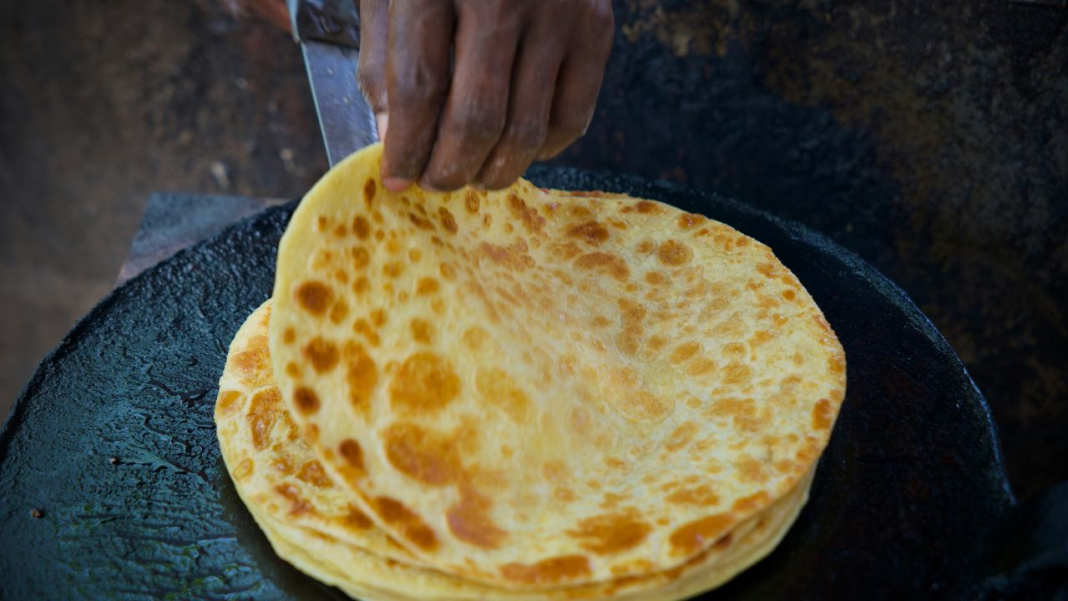
Later, they sat on upturned crates at his veranda in Buguruni, eating beans and chapati on a tin plate. She tried to tear the chapati like bread. He stopped her gently, showing her how to fold it, scoop the beans, and then bite. “No, no. Watch,” Mwai said, folding the bread with practiced grace, scooping beans, then biting in cleanly. She mimicked him, tongue poking out in concentration. When she finally did it right, he clapped softly. “Sasa unaelewa,” he said. “Now you understand.” “Next time,” she grinned and chuckled, “you eat tripe with chopsticks.”
They never called it love, not out loud. Her family back in Shanghai sent voice messages filled with questions she never fully answered, while his fellow officers tossed around jokes. Yet between the folding of chapati and the gentle clink of chopsticks, something enduring took shape. They built a language of gestures—chili oil dabbed on beans, glances held just a second longer than necessary, head nods that communicated understanding.
Sometimes, they sat side by side on the balcony above the market, watching the street lights flicker on like lanterns in a waking dream. Below, Ursino Street surged with life—wholesale crates being dragged in before dawn, incense smoke curling from temples, children weaving in between the legs of aunties and uncles, yet both had grown to understand. It was in this blur, this borderless belonging, that their connection found its strength.
There were no declarations, no grand promises, only the quiet labor of building trust: a jade pendant slipped into his pocket “for protection,” a carefully wrapped chapati tucked into her bag “in case she forgets to eat.” In their shared rituals, they imagined not a perfect future, but a possible one stitched from patience, humor, and the willingness to learn each other’s ways without needing to erase their own.
On Ursino Street, where the city remakes itself every morning, they stood as proof that even in the thrum of difference, something gentle could grow. Not love at first sight, but love in translation: slow, brave, and unfinished. The kind of love that waits for rain, and then walks home under the same umbrella.
Afterword
From Kariakoo to Kawe, in markets, ports, and quiet flats above hardware shops, the mosaic of Dar es Salaam comes to life stitched together with the scent of sesame oil and the clang of Swahili and Mandarin echoing through the heat. These stories of unlikely neighbors, borrowed languages, and shared meals are not just Dar’s alone. They ripple outward—through Johannesburg, Paris, New York, Lima, and Bangkok—tracing the fault lines and friendships of a world quietly redrawn by new migrations, soft power, and the everyday dance of co-existence. This is not just a Tanzanian story. It’s a global one seen best, perhaps, from Dar es Salaam’s street corners where chopsticks and chapati meet.
–
*This piece has been awarded First Prize in the category of fiction in the Second Global China-Africa Writing Competition (2026) held by CASIN (China-Africa Shanghai International Network). The competition is managed by Dr. Flair Donglai Shi (Shanghai Jiao Tong University), under the directorship of Dr. Jodie Yuzhou Sun (Fudan University). The judging panel of 2026 consisted of Dr. Lifang Zhang (Tsinghua University), Dr. Kaiyang Xu (China Foreign Affairs University), and Mr. Eric Mupona (Zhejiang University). The piece was originally written in English. The Elephant has permission from both CASIN and the author to publish it first. For more details about the competition and CASIN, contact us at casinwriting@gmail.com.