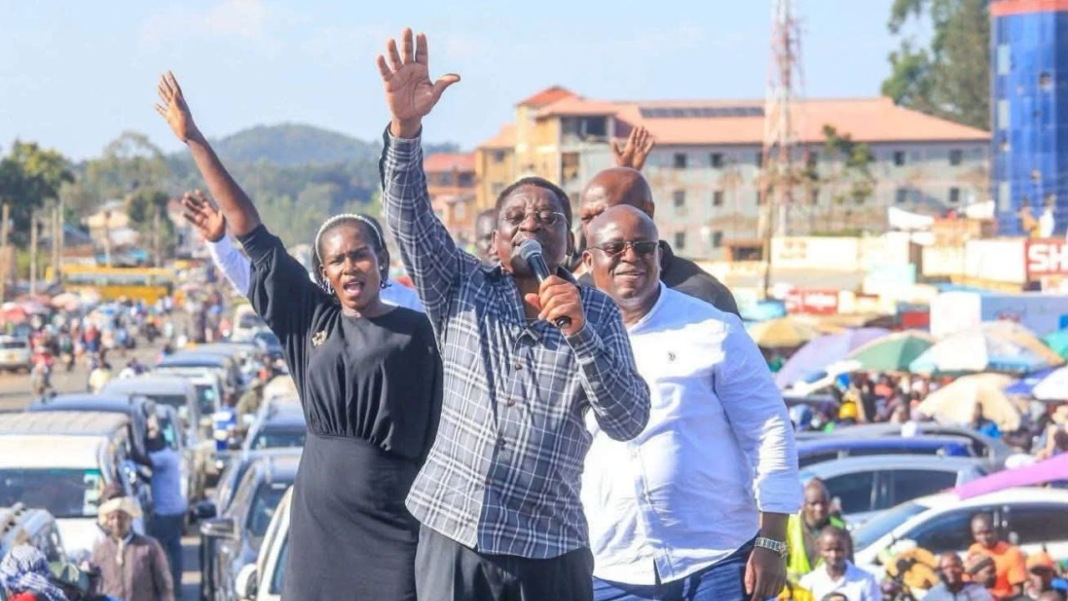
The political violence that characterized Linda Mwananchi’s forceful entry into Homa Bay and earned the county online mimetic mockery and nicknames such as Afgoonistan or Yemen didn’t begin in either the dust bowls of its lakeside town of Nyandiwa or the dusty roads of the county’s Ruma National Park, the route that the Linda Mwananchi entourage took to the heart of Homa Bay County, Asego ka DC, the administrative headquarters.
It began in India with the intestate death of Raila Odinga. For over two decades, Raila’s charismatic leadership and competitive presidential ambition singularly disciplined both leaders and voters in Nyanza. Although it was the magnet that attracted disciplined ideologues, crass opportunists, and fellow travellers in Nyanza’s politics, it held competing egos and political ambitions in check. It also maintained a delicate balance within ODM: the contradictory or opposed politics of protest against the powers that be and the politics of protecting the powers that be, as the case may be, as well as the Luo elite politics of righting the wrongs of Kenya’s postcolonial state primarily as a national common good and only secondarily as a particular Luo ethnic good.
Raila is dead. It is the end of an epoch. A new leadership struggles to be born in his Nyanza strongholds. Now it is time for monsters: castration angst, misogyny, sexism, mythical histories of Luo origins and migration, the bitter historical memories of postcolonial betrayals, elite and ethnic tribulations. Violence.
Homa Bay’s road to “AfGoonistan” on 16th August began when James Orengo, Siaya governor and a Linda Mwananchi advocate who is also popularly known by nicknames such as Nyatieng’, wuod nya Mayanga, or “the walking constitution”, took to the sun roof of his car and made an incendiary, vulgar, and sexist speech in May.
In a speech “full of sound and fury, dignifying nothing” in Kadongo, the far-flung fecund highlands of Homa Bay County where peasants grow some of Kenya’s sweetest pineapple and sweet potatoes, Orengo fired the first sexist and vulgar salvo against Homa Bay governor Gladys Wanga, in Dholuo. True to his Nyatieng’ moniker, Orengo hit Governor Wanga below the belt. He said:
“Dhi nyis nya Wangaya, ni an ja siasa ma ok onego otug godo. Ase neno siasa ma opogore gi siasa ma oseneno. An ok alony siruaru ni ngato. An ok alony siruaru ni ngato. Ma saa duto oloso mana e nyinga, an ma enana ni, an ok nindo koda, an ema anindo gi ngato. Koso awacho ma rach? Koso awacho ma rach? Moko wacho ni Orengo otii, sani e koro ka aroch, sani abith. To ka oneno ni ati, obi otem, one mach, koro e ka obiro neno. Kadongo Oyee! Kasipul, Oyee!”
“Go tell Nya Wangaya [Gladys Wanga] that I am a seasoned politician she should not joke with. The kind of politics I have experienced is different from what she has seen. I do not strip my panties for anyone. I do not strip my panties for anyone. All the time she talks about me. As you can see, no one sleeps with me, I sleep with someone. Have I said something bad? Have I said something bad? Some say Orengo is old, yet I have now rejuvenated. I am virile. But if she thinks that I’m old, let her try, she will see fire, then she will know. Kadongo Oyee! Kasipul Oyee!”
Although Orengo had addressed Governor Wanga simply as “Nya Wangaya”, ordinarily a term of endearment, there was nothing endearing or romantic about his invitation. Orengo’s speech in Dholuo rhymed with Catherine MacKinnon’s syntax of “Man fucks woman”, an expression that captures the contemptuous diminution of women to mere sex objects and women’s bodies to sites where violent men perform their patriarchal heterosexual fantasies.
If Orengo often punctuates his political speeches with words such as “dhako wadwa, mon wetena” – “fellow woman, fellow women” – to signal symbolic identification with the womenfolk, when challenged by a woman leader in the ODM leadership struggles, Orengo reached for the phallus. The walking constitution’s velvet gloves were off. He was revelling in the privilege of the phallus, to cheers from the crowd surrounding his car. He came to Homa Bay to express a strong patriarchal will to power.
Orengo’s vulgar, sexist speech in Homa Bay County – a county that not only elected the first woman governor in Nyanza and chair of the ODM party, but also boasts three elected women members of parliament out of eight constituencies – signified the end of an era: the end of civil politics of persuasion, respectful disagreement, dialogue, and tolerance between Orengo’s own Linda Mwananchi and Gladys Wanga’s faction of the ODM party in the broad-based government coalition.
Although the NCIC did not sermon Orengo, as they often do politicians who incite ethnic violence and hate, either because they do not take sexual violence seriously or because they ignore misogyny, many leaders, especially women leaders in Nyanza, were appalled by the demeaning speech and condemned it.
Despite being publicly stripped of her dignity and the pain she felt, Gladys Wanga’s immediate reaction was civil and conciliatory. Writing on her Facebook page in various capacities as “a daughter, mother, wife and woman”, she expressed dismay at Orengo’s utterances. She regretted Orengo’s descent from the high political pedestal where he “represented courage, conviction and possibility of principled leadership”, to the politics that “ridicules and diminishes a leader because of her gender and age and laced with echoes of gender-based violence, exclusion, intimidation in the workplace and public space”.
Indeed, to the older residents of the Rachuonyo constituencies, Orengo’s sexist and vulgar outbursts signified something ominous. It recalled the uncivil politics of David Okiki Amayo in the late 1970s and 1980s Karachuonyo constituency elections. It was a contest that mostly pitted Okiki Amayo against the indomitable Phoebe Asiyo, “Nyar Agoro”.
On such occasions, Amayo often uttered sexist remarks such as “Dhako ma okarore kuoma”, “that woman who is standing embarrassingly astride my body”, pleading with the voters to help him get rid of Nyar Agoro. Such utterances betrayed Amayo’s political castration anxieties, a profound fear of loss of masculinity in a political contest against a formidable woman politician. Ominously, such utterances also heralded the coming of political violence against Pheobe Asiyo and her supporters.
What often followed Amayo’s sexist vulgarity were swarms of stick-wielding men riding bicycles, violently shaking their walking sticks in the air to the battle cry of “Ounde! Ounde!” and intermittent shouts of “Okwaju onyidh kuome” as they rode to Asego ka DC, or gathered outside the South Nyanza County Council hall, loudly calling for Asiyo to be “beaten into shape” and threatening to “let walking sticks drizzle on her back like light rains”. Yet, when the political dust settled, Okiki Amayo, despite being the Kanu national chairman, resoundingly lost.
Was James Orengo expressing a similar political castration anxiety in Kadongo-Rachuonyo writ large? Orengo, it seems, also harbours a patriarchal fear of losing to an equally formidable woman leader from Homa Bay in the ongoing struggle for supremacy in Nyanza politics.
Following Jaramogi Oginga Odinga’s death in 1994, a fierce struggle for control of Nyanza – Jaramogi’s bedrock of national politics – ensued. It pitted Raila Odinga, his biological son, and James Orengo, who was widely and highly regarded as his political son. In that struggle for political dominance, Orengo had the support of nearly all the Nyanza MPs who had been elected in 1992 and enjoyed national name recognition like Dr Oki Ombaka, Professor Anyang Nyongo, Otieno K’Opiyo, and Professor Ouma Muga. Orengo had the support of Jaramogi’s brain trust.
In contrast, Raila had the support of the newly elected MPs such as Orwa Ojode, Oburu Oginga, and Tom Onyango, who had been elected in the by-elections that followed Kanu-induced defections of opposition MPs after the 1992 general election, and MPs who owed their victory to Raila as Ford-Kenya’s indefatigable director of elections.
In Homa Bay, Raila lost the support of Prof Ouma Muga, Member of Parliament for Rangwe Constituency. He began to work with aspiring MPs such as Dr Shem Ochuodho, Michael Onyango Obiga alias Akiro East Africa, and Councillor Otieno Ko’Woo, to woo voters, especially after defecting to the National Development Party.
In 1997, Raila, through the National Development Party, won most of the parliamentary seats in today’s counties of Homa-Bay, Kisumu, Migori, and Siaya. He announced his arrival as the dominant leader in Luo politics who would command the unwavering respect and loyalty of voters, especially in Homa-Bay. The NDP won all the Homa Bay parliamentary seats: Orwa Ojode (Ndhiwa), Oloo Otula (Kasipul Kabondo), Adhu Awiti (Karachuonyo), Otieno Kajwang (Mbita), and Shem Ochuodho (Rangwe), were all new to parliament, with the exception of Orwa Ojode, who had been elected in a 1994 by-election.
Unlike Siaya or Migori or Kisumu, where he lost one or two seats in the 1997 general elections, and would still lose one or two seats in subsequent general elections to other parties, Raila retained a tight grip on Homa Bay politics throughout his sojourn in the NDP and the Liberal Democratic Party, and during his long stay in the Orange Democratic Party.
Although, like Joe Donde, Orengo survived the NDP wave in Siaya, his political rivalry with Raila played out violently from 1997 to 2002. During this period, while Raila pursued politics of “cooperation”, of compromise, and accommodation with Daniel Moi’s government, Orengo stuck to a principled opposition to the government and pursued politics of a vote of “no confidence” against Moi in parliament. Where Raila championed parliament-led constitutional reforms, Orengo championed popular constitutional reforms through the Ufungamano process. However, this contest often turned violent. Orengo and his supporters were often on the receiving end of violence perpetrated by the pro-Raila groups in places such as Ugunja, Kisumu, and the main campus of the University of Nairobi.
In 2002, Orengo suffered a huge loss, both as the Social Democratic Party’s presidential candidate and as the candidate for the Ugenya Constituency parliamentary seat. Raila’s loyalists such as Otieno Kajwang gloated over Orengo’s electoral humiliation. They often cited Orengo’s fate in the 2002 general elections as a caution against challenging Raila’s dominance in Nyanza politics. Otieno Kajwang’ likened Orengo to a footballer who sustains a serious groin injury because he keeps ignoring the coach’s warning against the unorthodox style of kicking the ball high in a football match.
In 2007, Orengo ran for the Ugenya parliamentary seat on Raila’s ODM party ticket. He made a spectacular comeback at the Kenyatta International Convention Centre as chaos engulfed the 2007 presidential election. But he would henceforth play second fiddle to Raila’s politics, both in the politics of the Luo nation and in national politics.
Currently, the Luo nation is caught in the vortex of the cross-currents of Raila’s alternate politics of protest and righting the wrongs of Kenya’s postcolonial state, or of accommodation with the evils of Kenya’s successive governments in exchange for power and patronage after a general election.
The Luo nation needs a leader. If Kasipul Kabondo MP Otieno K’Opiyo’s 1996 assertion that “we are fed up with talk that the Luo have no leader. And we declare here today for all to hear that Orengo is political spokesman after he beat Raila at an election attended by all MPs from the community,” came to naught; then, today, Linda Mwananchi’s wantam politics puts Orengo in a good position to inherit Raila’s political crown, a desire he expressed explicitly on the 13th of September, symbolically depicting the Linda Mwananchi’s Nairobi rally as his own crowning moment in a post on X captioned “When we hit the city, we ride with Baba’s spirit! Kanairo Hoyeeeee!!”
Unlike in the period after Jaromogi’s death when Orengo had the support of Jaramogi’s brain trust (but not necessarily that of Luo voters), he currently has a significant following among ordinary Luo voters and aspiring MPs, but the support of only one MP from Nyanza, Karoli Omondi of Suba South, who resolutely supports his politics of protest and righting the national wrongs of President Ruto’s broad-based government. It is a politics that resonates with a significant cross-section of youthful Luo voters, who are also dissatisfied with the performance of most of the current crop of MPs and governors.
Once more, Orengo can make a comeback as the leader of the Luo nation. He can do so with a popular support base and without Raila’s untidy political compromises. However, his vulgar sexism in Kadongo betrays the castration angst of a man who fears losing a political duel for the soul of Raila’s political constituency, especially to a political neophyte like Gladys Wanga, “A Beautiful One” who had not been born when Orengo first became the MP for Ugenya and a household name nationally.
Although Wanga’s immediate reaction to Orengo’s incendiary speech was conciliatory, a stone was thrown at his convoy in warning when an unapologetic insolent, imperious and impetuous Orengo returned to Homa Bay. His convoy was attacked by goons and one person was seriously injured. This attack strongly signalled the end of the era when Homa Bay women leaders, slapped on the cheek, would quietly and effectively mobilize their supporters, especially women voters, to hand their opponents a handsome defeat in a leadership contest like Phoebe Asiyo used to.
By the time Linda Mwananchi announced its date for the Homa Bay rally, most of the elected Homa Bay leaders, reeling from the sting of what they saw as Orengo’s imperious, impetuous and disrespectful forays into Homa Bay County, were mobilizing goons to defend their dignity, honour, turf, and broad-based government by any means necessary.
Meanwhile, driven by his desire to demonstrate that he is a seasoned politician whom Gladys Wanga and other junior leaders from Homa Bay should not joke with, and with the support of only one elected MP from Homa Bay, South Suba MP Karoli Omondi, and the Linda Mwananchi cast, James Orengo was ready for a showdown. Orengo came not only to exercise his hard-won constitutional rights, but also to assert his dominance, with mobilized van-goons of democracy to boot, ready to violently break and counter any resistance.
That Sunday, the demons haunting Raila’s succession came out. Not the hired goons riding on bicycles and wielding walking sticks of the 1980s but swarms of panga-wielding goons on motorcycles baying for blood as they patrolled or rode into the Asego ka DC county headquarters.
The competing narratives of the Luo nation’s political histories by various political camps – such as Migori governor Ochillo Ayako’s mythical history of the Sinakuru Kukulabanga Madog Nam as the great-great-grandfather of all Kenyan nilotes, Omondi Karoli’s history of the Luo as linchpins in coalition building in Kenya’s politics, and John Mbadi’s politics of bitter memories of Agikuyu elite betrayals – all took a back seat.
Homa Bay’s throat was caught between the sharp edges of the machete blades of the pro-broad-based government goons and those of the van-goons of democracy. The government, it seems, happily held the ring for a violent proxy fight between the goons mobilized by the ODM leaders in the broad-based government in defence of their dignity, turf, and politics of righting only the successive post-independence national wrongs against the Luos, on the one hand, and the Linda Mwananchi’s movement and their democracy van-goons in defence of the politics of righting the wrongs of President Ruto’s broad-based government against all Kenyans as well as exercising their constitutional rights.
At dusk, when the dust kicked up by the Linda Mwananchi rally finally settled, Asego Ka DC sat forlornly at the foothills of Asego Hill, still overlooking the rocky island of Soklo Kipenji of Nam Lolwe, symbolically penetrated by Orengo, but not yet “colonized” by the Linda Mwananchi movement, as Embakasi East Member of Parliament Babu Owino had promised. Two people were dead, some women had been raped, scores were seriously injured, and several properties destroyed.