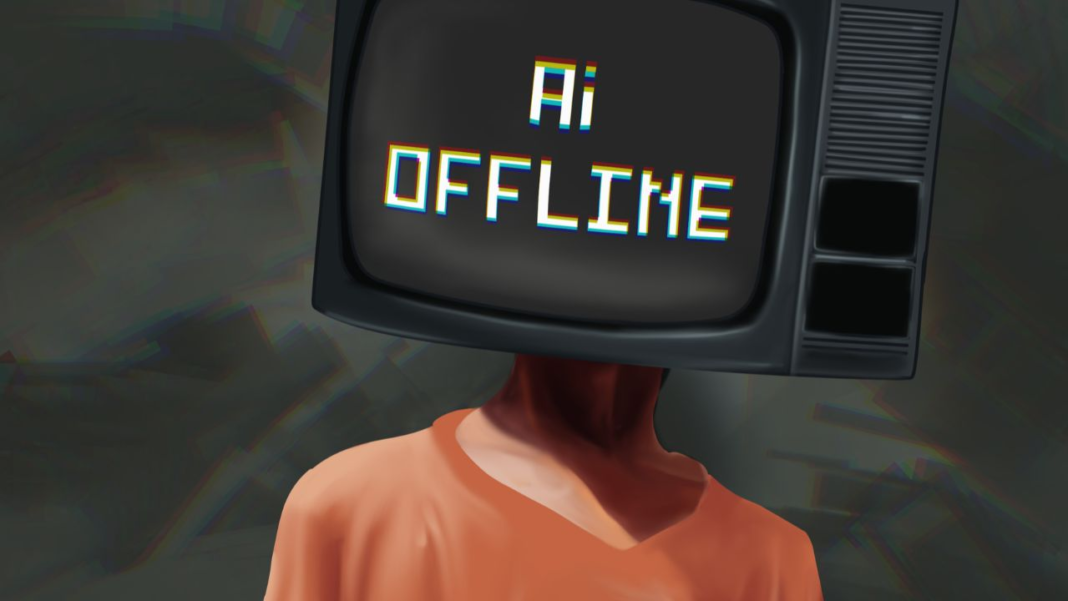
The conversation around Artificial Intelligence (AI) in the creative industries is often filled with hype and speculation. Is it a tool for liberation or a threat to livelihoods? Chief Nyamweya, co-founder of the Kenyan animation studio Pungulu Pa Productions, cuts through the noise by sharing his on-the-ground experience developing the African children’s series Uli and Tata. He explores the practical realities, ethical dilemmas, and unique opportunities AI presents for artists, particularly those from the Global South.
Q. As a creator, what has been your view of the interaction between art and state structures?
A. Our team was stopped at a police checkpoint during a research trip. The tension was high as we unpacked our gear. As an officer questioned me, I showed him my sketchbooks filled with dozens of drawings of camels that I had made during our trip. His demeanour changed completely and we ended up laughing together, in awe at the camel’s unique gait. Our driver was confused by the transformation. As we left, I told the officer to look for us on YouTube; my phone battery was dead, but thankfully, sketchbooks don’t need charging.
Q: As an animator creating content for African children, what was your initial, practical view of AI tools?
A: My approach was to see AI as a potential tool, not a magical solution. At our studio, Pungulu Pa, our mission is to create content that inspires African kids to love their land and culture – a direct response to the lack of quality, culturally relevant animation. We started with intensive, on-the-ground research, like travelling to Kakamega Forest to listen to stories and observe wildlife. So, when engaging with AI platforms like DALL-E or Midjourney, I evaluated them based on a simple question: are they a solution in search of a problem, or a genuine companion for a creative like me? The answer, I found, is complicated.
Q: Animation is a complex process. Where does AI fit into the “production pipeline”?
A: Animation isn’t just a software function; it’s a multi-stage “production pipeline” involving fundraising, research, screenwriting, storyboarding, voice acting, animation, and more. For our series Uli and Tata, primary research alone consumes 15 to 20 per cent of our budget because we are committed to archiving and accurately representing African cultures, avoiding the stereotypes you might find with a simple Google search.
In this context, AI’s potential is twofold. On one hand, giant Hollywood studios may use the “AI scare” to lay off workers. On the other hand, for a young industry like Kenya’s, where most studios are small and survive on corporate client gigs, AI tools could be a lever to close the gap with bigger players. As my friend and Art Director Shaddie has demonstrated, by building AI agents that mirror our pipeline, we have every incentive to grab any tool that might help. After all, how can you be disrupted when you’re not even at the feeding table yet?
Q: So, you experimented with AI. What was your hands-on experience like?
A: I decided to train as an AI storyboard agent. Storyboards are rough drawings that plan out an animation and are a major bottleneck in any pipeline. I thought it would be a perfect test because image quality isn’t the priority. However, I quickly hit a wall. I was spending more time training the AI – translating my thoughts into perfect text prompts – than if I had simply picked up a pencil and drawn the storyboards myself. This led me to a fundamental question: isn’t the whole point of freehand drawing to witness the unmediated mind of a human being?
Q: Beyond practical hurdles, what are the ethical concerns for artists?
A: The ethical issues are profound. First, there’s the issue of theft. AI companies are facing lawsuits because their models are trained on the work of artists without permission or compensation. The argument that “we are building the future” is vacuous. As technologist Dr Dwayne Munroe cautions, we risk projecting creativity onto what is essentially sophisticated statistical mimicry.
Furthermore, the “hidden costs” are alarming. The tech industry’s extractive logic treats artists as invisible, uncompensated data suppliers. Worse, we’ve learned that underpaid Kenyan workers are exposed to violent and traumatic content to “clean” AI training data for Western users. There’s also a deep cultural bias: these datasets overwhelmingly reflect Western aesthetics, threatening to further marginalise African traditions that are not widely digitised.
Q: Given these problems, is there a positive path for AI in Africa?
A: Absolutely, but it requires a foundational first step: the digitization of African languages and ethically sourced knowledge. Imagine if institutions like the National Museums of Kenya created a public digital archive of traditional songs. This would not only preserve our culture but also subsidise the research for projects like ours.
Only after this can we embark on genuinely exciting experiments, like training a Large Language Model to speak the now-extinct El Molo language. However, we must be realistic. We cannot expect profit-driven Silicon Valley corporations to make these investments. In a capitalist system, an “AI-girlfriend” app will always be deemed more profitable than an El Molo language app for users without credit cards.
Q: What is the single biggest challenge facing Kenyan animators – is it really AI?
A: Not even close. The challenges highest on our list are access to capital and a conducive policy framework, like tax incentives. Skills training is a distant third. We have a situation of “over-capacitated” but unemployed animators because, after a decade of donor-funded training, there are still too few studios and projects to employ them. Skills are useless without the infrastructure – the “hospitals” – for them to practise in.
Q: In conclusion, how should we view this moment? Is AI the end of creativity or a new frontier?
A: It can be a new frontier, but only if we confront the system in which it operates. Training a machine to draw like us is an impressive achievement, but how much greater would it be if it wasn’t underwritten by theft and ecological destruction?
Our ultimate goal in Kenya shouldn’t just be to adopt new tools, but to upgrade our understanding of culture as defined in our constitution – as the foundation of our nation. This means breaking the silos between heritage, the arts, and technology, and ending the subordination of our culture to tourism. We must seize the means of telling our own stories. We can disrupt the production pipeline all we want, but if we don’t disrupt the cold, capitalist logic of distribution and profit, we’re merely rearranging the deck chairs on the Titanic. We are not mere spectators to history. We, too, have our story to tell.