
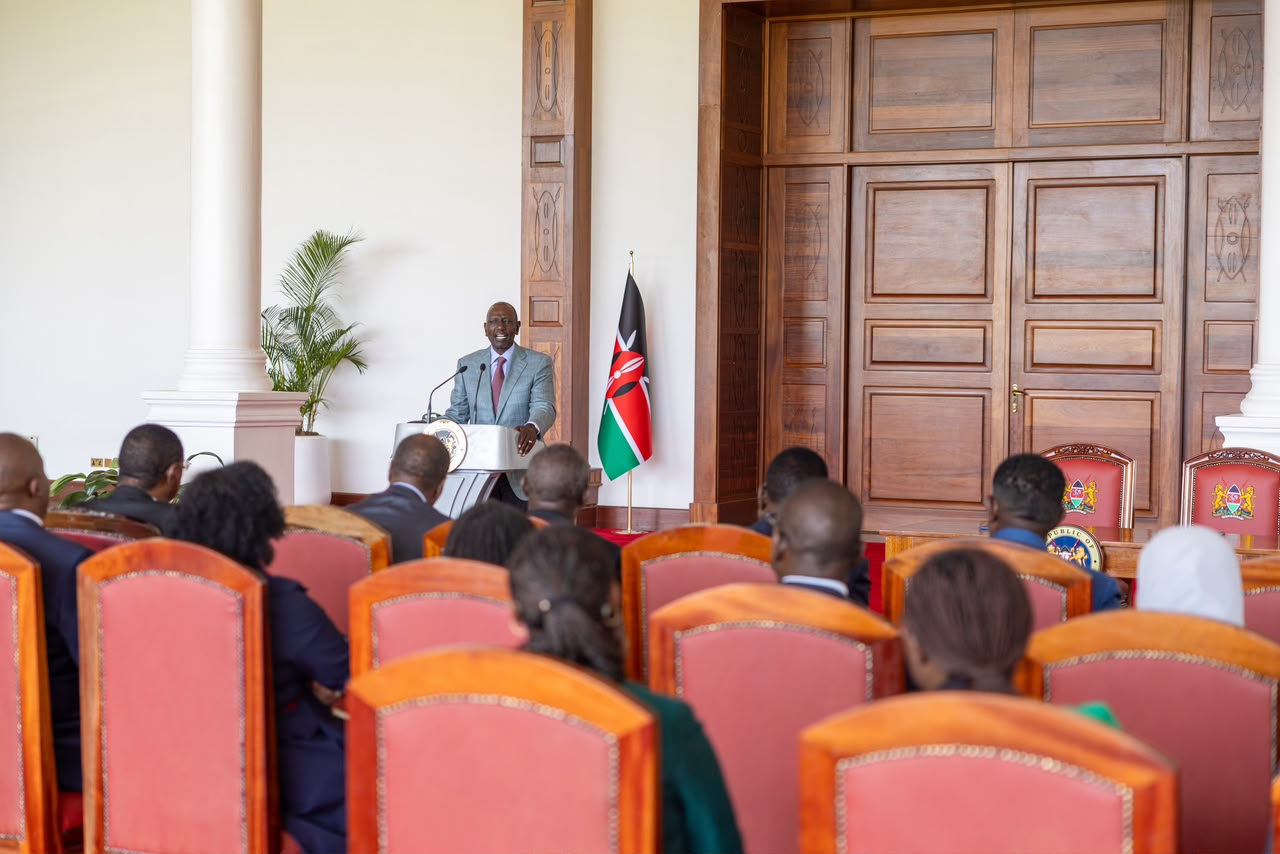
President William Ruto on Tuesday presided over the signing of a $3 billion Memorandum of Understanding (MoU) on electric vehicle manufacturing between the Government and Endelevu Enterprise Corporation at State House, Nairobi.
The integrated green mobility project will include manufacturing and assembling electric vehicles in Kenya.

The project aims to boost local assembly and manufacturing of electric vehicles.
Speaking after the signing ceremony, President Ruto said the investment would help Kenya stop exporting jobs by shifting from importing finished vehicles to adding value locally.
The President pointed out that the MOU provides a framework for one of the largest electric mobility investments in the region.
“This memorandum establishes a framework for an integrated green mobility ecosystem, with a proposed investment of $3 billion. It is one of the largest electric mobility commitments in our region,” he said.
Explaining that the proposal is concrete, he said it comprises an assembly plant for 50,000 four-wheel vehicles a year; a second plant for 100,000 two-wheelers and light mobility vehicles a year
He also stated that 1,000 solar-powered charging hubs and a digital platform to manage up to 100,000 green vehicles.
“Behind these numbers are people. The project is expected to create about 2,000 direct jobs and more than 20,000 indirect jobs among suppliers, logistics firms and service providers,” he said.
Additionally, the President noted that the project is also expected to create up to 80,000 further opportunities in fleet management, operations and services.
Two weeks ago, he recalled, he told the United Nations General Assembly: “We will not prosper by exporting what we
grow and mine, and importing what we use. Value must be added here. Skills must be built here. Jobs must be created here.”
He added: “In signing this MoU, we put that principle to work.”
The President also linked the Dangote East African Refinery in Lamu with the electric vehicle project.
“Barely a week ago, we broke ground for the Dangote refinery in Lamu. Today, in Nairobi, we sign for clean mobility. These are two investments with one direction.”
Noting that some will ask how one nation can refine petroleum and electrify its transport at the same time, the President said the answer is simple: “Energy security has more than one road. We will refine what we and the region still need, and we will electrify both present and future opportunities. This is not a contradiction; this is strategic synergy. On either road, the value stays in Africa, and so do the jobs.”
At the same time, President Ruto pointed out that every electric vehicle on the road cuts fuel import bills and eases pressure on the country’s foreign exchange reserves.
“Because our electricity comes predominantly from renewable sources, we can power our transport with Kenyan geothermal steam, Kenyan wind, Kenyan sun, and Kenyan rivers,” the President said.
He pointed out that when the country imports fuel, it imports price shocks, adding that when the country generates its own power, it generates its own stability.
“None of this happened by accident. Investors commit capital when the direction is clear, and the rules are predictable. That is why we launched the National Electric Mobility Policy in February this year,” he explained.
The President explained that earlier this year, the Government announced that the first 100,000 electric vehicles imported into Kenya would be duty-free.
“It is also why the Government has ordered 3,000 electric vehicles for our security and administration officers. We asked manufacturers to come and build in Kenya. Today’s memorandum is the answer,” he said.
He told Endelevu Corporation and Geely – its partner – that Kenya’s ambition goes beyond its borders.
“We do not want to assemble for one market. We want to manufacture for East Africa and for Africa,” he said.
He noted that vehicles built in Kenya and qualifying under the Rules of Origin of the East African Community will reach a regional market of hundreds of millions of people.
“This is the industrial future we are building through the National Electric Mobility Policy and the National Automotive Bill now before Parliament,” he said.
President Ruto stated that Kenya expected investment and industrial capacity, jobs for young people and contracts for the SMEs as well as technology and skills to be transferred.
The President also directed the Ministry of Investment, Trade and Industry, through Ken-Invest, to provide all the necessary support to the investor.
He said the ministry will also work with every relevant national and county institution so that approvals, land, and infrastructure are delivered within clear timelines.
“A memorandum is a framework. It is not the finish line. We must move quickly from signature to definitive agreements, from agreements to groundbreaking, and from groundbreaking to production,” he said.
The President made it clear that Endelevu Corporation will be measured by what it builds, adding that the Government will be measured by how fast it clears the way.
Investment and Trade Cabinet Secretary Lee Kinyanjui said the MoU will help reduce Kenya’s dependency on imported petroleum.
“President Ruto has prioritised the automotive industry in this country in an effort to boost local assembly and manufacturing of electric vehicles in Kenya,” he said.
Endelevu Enterprise Corporation Chairman Susong Tong said the MoU marks another milestone in Kenya’s automotive industry.
National Assembly Speaker Moses Wetang’ula, Cabinet Secretaries John Mbadi (National Treasury) and Davis Chirchir (Roads and Transport) were also present.