✦ Executive Briefing
Agribusiness & Dairy Value Chains
📌 Key Takeaways
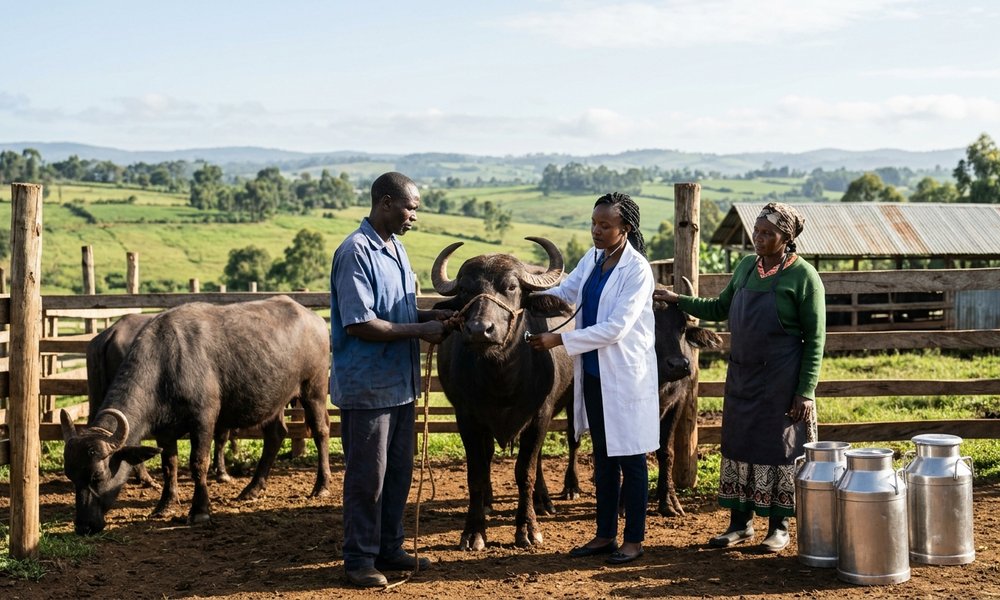
- Legal Recognition Under Gazette Notice No. 977: Kenya formally declared the domesticated river water buffalo (Bubalus bubalis) a legal food animal under the Meat Control Act, opening commercial pathways for high-fat dairy and lean carabeef production.
- Doubling Butterfat Margins: Modelled on India’s Amul cooperative revolution using Murrah and Nili-Ravi river breeds, domesticated water buffalo milk contains roughly twice the butterfat of standard cow’s milk—ideal for high-margin mozzarella, ghee, paneer, and artisanal yoghurt.
- Complementing Kenya’s 5.4B-Litre Dairy Herd: Rather than replacing dairy cattle, water buffaloes diversify smallholder resilience against drought while feeding leather tanneries and organic biogas systems under the Bottom-Up Economic Transformation Agenda (BETA).
- Biosecurity & Conservation Guardrails: Scaling the sector requires strict KALRO veterinary quarantine protocols for imported semen and embryos, alongside digital ear-tagging to prevent illegal bushmeat poaching of Kenya’s protected wild African cape buffalo.
Climbing the Dairy Value Chain Beyond Raw Milk Commodities
Kenya already produces approximately 5.4 billion litres of cow’s milk annually, yet smallholder farmers remain trapped at the lowest-margin rung of raw liquid commodity sales while hospitality chains import premium cheeses and butterfat derivatives. By gazetting the domesticated Asian river water buffalo (Bubalus bubalis) under the Meat Control Act via Gazette Notice No. 977, policy planners have unlocked a livestock asset whose milk carries nearly double the fat and total solids of conventional dairy cattle—the exact biochemical profile required for high-value buffalo mozzarella, clarified ghee, paneer, and export-grade carabeef.
Crucially, commercial success across our Business & Agribusiness landscape depends on disciplined execution rather than premature livestock imports. As researchers led by Dr. Yusuf Muchelule emphasize, the Ministry of Agriculture and the Kenya Agricultural and Livestock Research Organization (KALRO) must prioritize biosecure semen and embryo transfers to screen out bovine tuberculosis, anthrax, and foot-and-mouth disease while enforcing strict traceability so protected wild African buffaloes are never laundered into commercial meat channels.
Cooperative Processing & Diaspora Agribusiness Investment
India’s dairy miracle succeeded not merely because of Murrah and Nili-Ravi genetics, but because cooperative federations like Amul placed chilling hubs, KEBS-grade specialty cheese plants, and fair milk-solids pricing directly in the hands of rural producers. Replicating that cooperative architecture across suitable Kenyan counties will generate MSME jobs spanning cold-chain logistics, specialty cheesemaking, leather tanning, and biogas fertilizer production.
For agricultural syndicates within the Kenyan Diaspora Network, financing modular cottage cheese processors and solar-powered rural milk chillers offers a high-margin entry point into Kenya’s Agricultural Transformation.